No doubt everyone is wondering what we are riding on and carrying with us during the day. Sara is carrying all the camping gear. But we’re still loaded down.
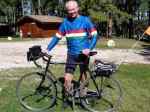 My bike is a TREK 520 ($1,200), a steel touring bike that weighs approx. 30 lbs. with the three bottle carriers, rear rack, and extra liners in the tires. My tires are currently a mix of brands; Bontrager and Continental Gatorskins ( $40 each). Each tire is fortified by a line of thick plastic tape between tire and tube, so minor pinprick flats don’t happen. I have only had 2 flats in 1,600 miles. I ran over a jagged piece of metal that tore a 2″ gash in one tire….wooosh went that tube. And 2 days later wooosh went $50 for a new tire. The bike and all the gear/water/food/clothing weigh about 50 lbs.
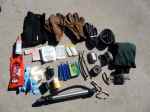 In the rear bag I carry the following: assorted bandages; 2 tubes & tube repair kit, tire levers, spoke wrench, all purpose tool, latex gloves to attempt to keep grease off the hands and clothing, electrical tape to put a temporary “patch” on large holes in the tires, leather gloves to assist in getting the tire back on the rim ( very stiff tires/ weak fingers), a portable but not small air pump that will pump 120 psi ( $40 for those who wonder what good equipment costs) Most pumps stop at 80 psi. I also carry handiwipes, sunscreen, vitamin I (Ibuprofen, for those of you under age 40), a flashing red tail light, a small canister of bag balm, an extra knee brace in case my good knee goes bad, reading glasses, and finally pepper spray for dogs. This is really just a psychological aid, since it is so buried in the pack I could never retrieve it while on the move.
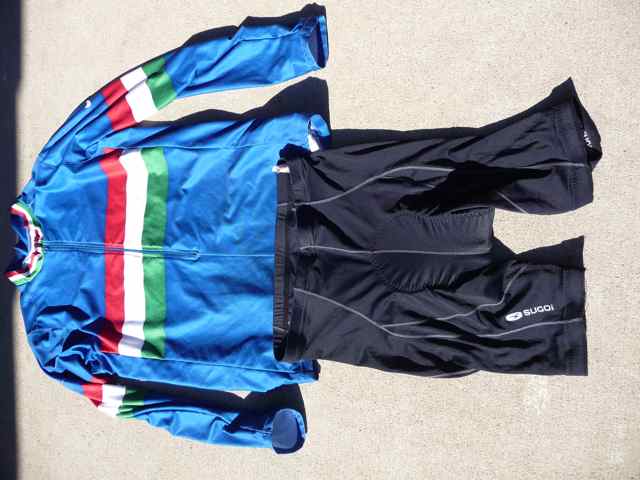
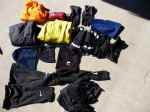 The rear bag can also have any or all of the following: an orange vest, one of three extra pairs of gloves for warmth/ wind/ rain protection, a heavy duty rain jacket and pants ( which cost more than $200), and leg and arm sleeves that can be pulled up or down as needed for warmth. I might pull them up for a cold 30 mph downhill or roll them down for a long uphill. I also carry one of three different caps under my helmet for sun/wind/cold protection, and a neck gaiter for cold. There are lots of clothing choices, and we don’t always guess right, especially this past Saturday when we started out from Spearfish in a cloudless sky and temps in the 70’s and ended up in a north wind driven cold front with low 40’s and rain. This has happened to us before so we should know better.
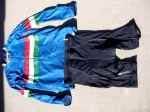 It never fails that guys will ask us how our butts handle those tiny seats. I observe that cyclists have a variety of approaches. Mine was to throw $125 at the problem. Thanks to Chad at the Geneva Bike Center back home, it was the best money I ever spent. I bought two pair, and my previous ” way too expensive” $75 pair have not been used on this trip. What do you get for that over- the- top price?
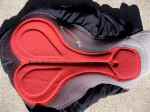 You get “Baboon butt” one-piece foam padding that will return to its original density and shape. And leg grippers that work. And the padding does not give you that diaper between your legs look. We hate that.
Warning: the following text could be disturbing to children and certain adults.
Most touring cyclists will use some kind of ” crotch butter/gel/cream” to prevent chafing. I go to my local ag supply store to buy mine. It is also known as udder butter. Mooo.
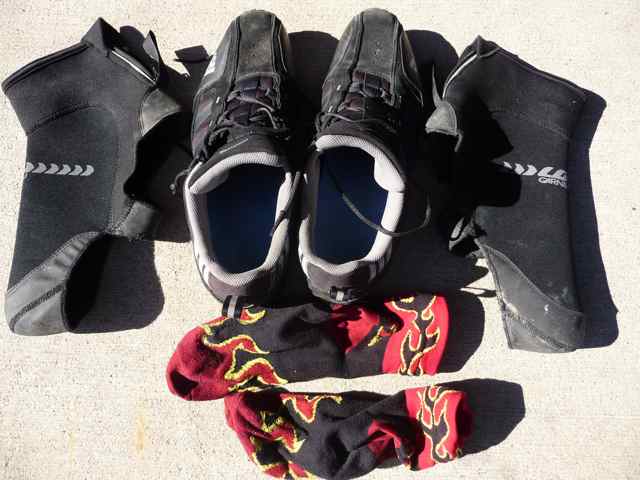
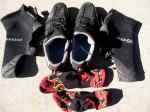 Shoes have clips on the soles that fix ( trap) the shoe and foot to the pedal for a more effective and efficient pedal stroke. They allow you to not only push down but pull up. It took two falls to earn to unclip them before stopping. My shoes come with red flame socks, thanks to my two grandkids Alison and Emma.
Neoprene over- boots help keep some heat in on cold wet rides, but do not keep water out.
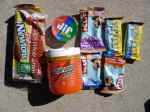 I learned about energy bars from Brad. He prefers “Clif bars” which he calls hippie cookies. I like Luna bars, but they are marketed for women. After a long ride, we get a bit punchy and the same old jokes start flying about our bar choices. On a 70 mile ride I will eat 4-5 bars, each of which has approx. 200 calories, 30 grams of carbs, and 10 grams of protein. I use Gatoraid in my water to add about 200 more grams of carbs during a 5-7 hour ride. My energy level remains high for most of the rides, depending on wind direction. We have had head winds during portions of most every ride for the past several weeks.
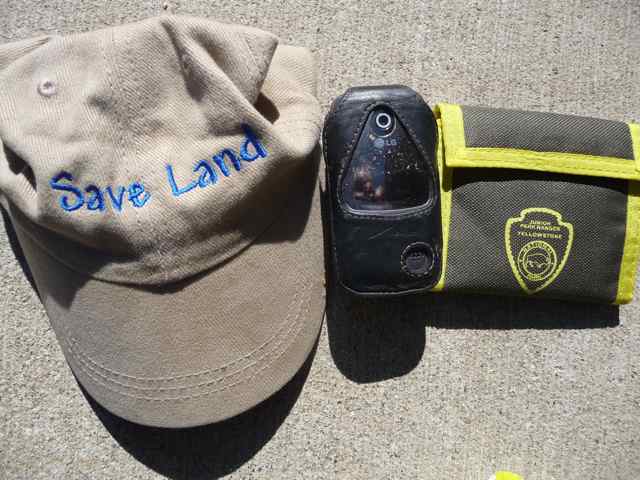
 I also carry a cell phone, camera, cap, and my “junior ranger” wallet. Not pictured are the maps that we carry and usually refer to. We have not had much insight on elevation changes for some of our roads. We really paid dearly for that yesterday in the Black Hills ( aka Black Mountains).
That is what 20 lbs of “gear” can look like. What have I forgotten?
 Belle Fourche, a small town at the western edge of South Dakota, says that it is exactly halfway between the East Coast and the West Coast. We passed just south of it when we crossed the state line on Friday, September 12. Our trip is ten weeks long, and we completed the fifth week on Monday the 15th, so at the halfway point we were on schedule. South Dakota marked the beginning of the second half of the trip in another way, too. Between Glacier and the Black Hills, we followed a zig-zag line that ran south and east. After Rapid City we headed more or less straight east, to dip our tires in the Atlantic Ocean on October 22.





 Brad Edmondson