Categories
5. Iowa & Minnesota Bicycling Across The USA

Days 43 & 44: Jackson to Spring Lake, MN

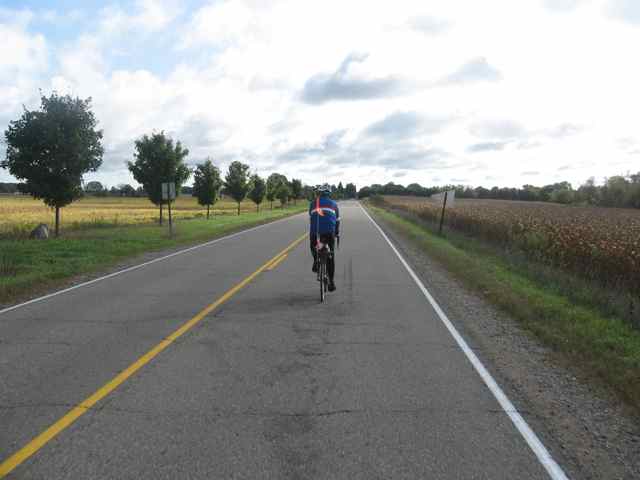
I always used to say that if you’re bored, it is your own fault. It means that you aren’t looking hard enough because something interesting is always there. On Tuesday and Wednesday, September 23 and 24, Minnesota’s county roads tested this truism. Each day was a trek of more than 70 miles through flat fields of corn and soybeans, punctuated by well-kept farmhouses. Sometimes 10 or 12 miles would go by before I noticed something (anything) different. On Tuesday we did meet three interesting men, though, and we did beat the rain.

We started off from Jackson around 9am, expecting to get wet. It was humid with a strong wind from the south, and the forecast called for thunderstorms. Minnesota’s Transportation Department publishes bicycle maps that show traffic counts and shoulder widths for state and county roads; we used these to chart a course parallel to and just south of Interstate 90. We would happily have charted a less direct route for scenery or some other notable thing, but we just couldn’t find anything (except for a “Liver and Onion Feed” coming up at the Eagles Lodge, but we couldn’t stay). So we hit the flat road, leaned into the wind, and burned up the morning.

The first interesting man was Larry Vogel, who owns the bike shop in Fairmont. Larry doesn’t advertise, he isn’t on the Internet, and he doesn’t want to be photographed. His shop is the only one in the 200 or so miles between Sioux Falls and Albert Lea. He plays horns in a group called the Tarnished Brass, and used to teach school. His shop is a chaotic combination of 20th Century bicycles of all types, metal toys, model railroad cars, tiny buildings for model railroad layouts, band equipment, sheet music, and a few bikes and other things for sale. The bikes are clearly not the main items. Larry did have the replacement safety flag Jim needed, though, and he gave us excellent route advice.

Larry is heading off to Wyoming next week to ride the Wind River Range, and he and Jim had a pleasant chat the way two Midwestern men do: with not much eye contact, watching their own shoes, and being helpful while also practicing one-upmanship. By the way, Larry has some top-of-the-line Trek road bikes ($2,000 to $4,000 or so retail) that he’s selling for ridiculously deep discounts just to get rid of them. If you want one, he would be worth a call.

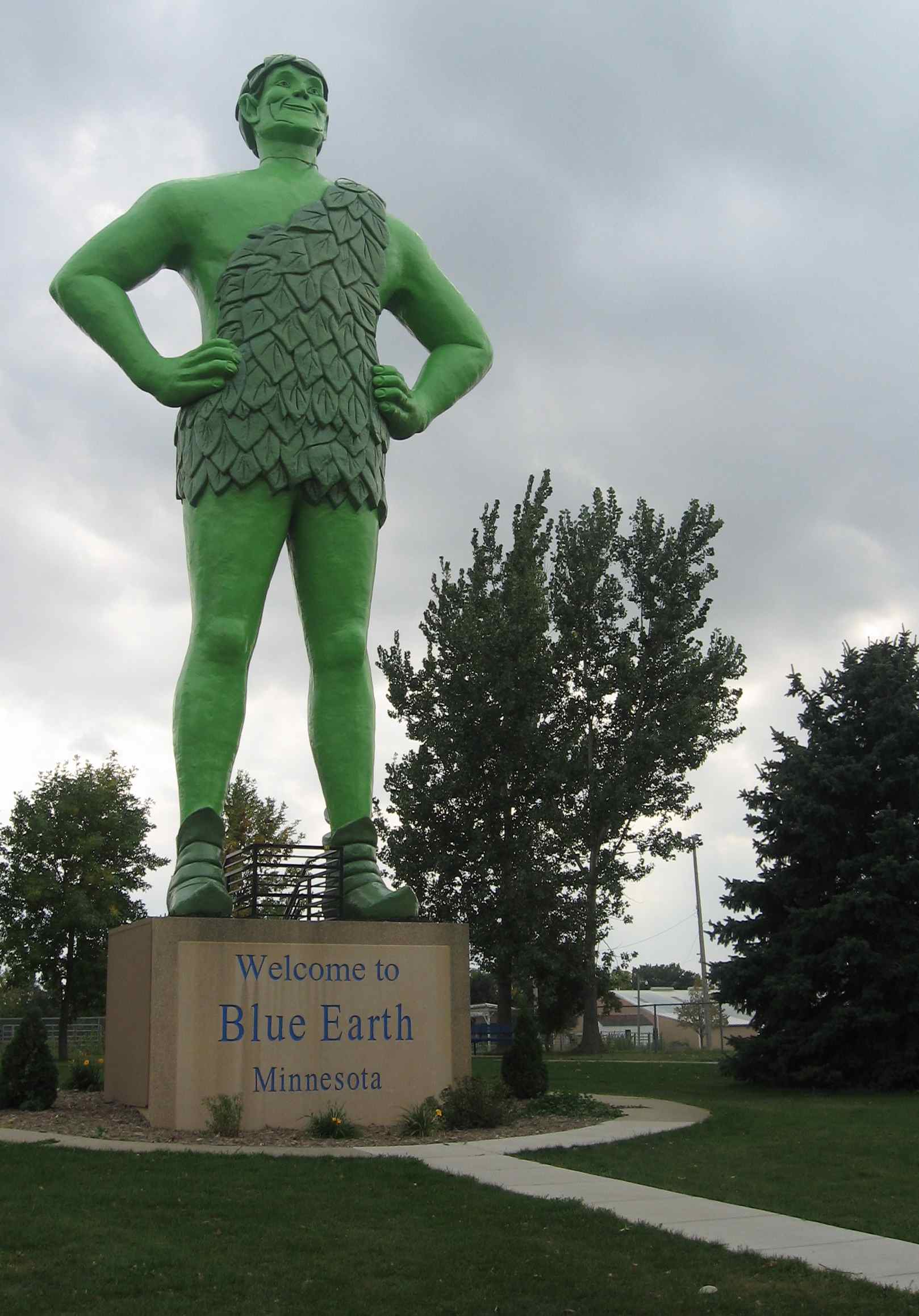
The second interesting fellow was in Blue Earth, and you also know him. The town keeps an 80-foot statue of the Jolly Green Giant next to Interstate 90, conveniently (for us) located next to the Dairy Queen. Jim climbed between the Giant’s legs and tried to grab his niblets, but he couldn’t reach high enough. I honestly don’t think the Giant has any, anyway.

The third interesting man was Paul More. Paul is the father of the young man who offered tea to Jim and Paul Kersting during a rainstorm outside of Yellowstone Park (for the complete story, see Jim’s post for Day 21). The tea-bringing Good Samaritan had said that his father owned an agricultural implement store in Blue Earth. We happened to ride by and Paul was outside, using an enormous wrench to bust a nut on a combine. He seemed pleased to hear that his son had made a kind and thoughtful gesture. We shared observations on what a small world it is. Then I heard thunder and we got back on the road.

We had ten miles to go and rain was building to the south and west. Scattered drops started to fall. They were big ones. I thought it was going to be another day of slogging through the last 45 minutes and arriving soaked. We pushed harder and managed to stay just on the fuzzy line where rain was imminent or maybe starting but not heavy. As we turned onto the gravel road that lead to Piehls County Campground, six miles south of Wells, a cold downdraft hit us and I was sure we were going to get it. We screamed into the campground and put our bikes under the camper, which Sara the Blessed had already set up. Within ten minutes, it was raining cats and dogs.

What intense pleasure and gratitude I felt, sitting in the dry camper with the rain pounding on the roof, knowing that my bike and shoes were dry and would be dry in the morning. Piehls had no wireless internet access, but the campground manager showed up later, refused to charge us when she learned we were riding for charity, and then offered to let me use her computer. The landscape may be boring, but the people in Minnesota are pretty great. The rain ended and there was a gorgeous sunset. As night fell, we watched a flock of turkeys calmly pecking at the edge of the cornfield next to the camper.

Day 44: Wells to Spring Lake, MN

We started early and had ridden perhaps 40 miles before Jim let out a whoop and circled back. “I found more money!”, he said. Looking closer, he found that it was only a spent, rolled up lottery ticket. That was about the most interesting thing that happened before noon. We rolled right through Albert Lea with only the briefest of bathroom breaks, and continued until we reached Austin, which as everyone knows is the home of Spam.

The Spam Museum is next to the Hormel Corporation’s headquarters. It’s free, and no expense has been spared. A wall of more than 3,000 cans of Spam encircling a spinning globe dominates the entrance. The Hormel people are well aware of their brand’s kitschy image and the many jokes that surround it, and the museum is a weird attempt to share in that self-deprecating humor while also shoveling vast quantities of corporate propaganda. I learned that Spam became a global product thanks to a massive procurement contract from the Defense Department during World War II, and I saw decades of print and television ads the company created to pound Spam into all of our heads. Spam has its own website now and yes, Hormel says, they are aware of the irony in this. The one true moment of genius in the museum is Monty Python’s sketch about ordering spam in the Green Midget Diner. This shows on demand in a scale model of the diner itself. Otherwise, the museum was kind of slick and creepy.

We spent an hour at the museum and another hour finding a milkshake, then rode off for another 30 miles through the cornfields. Wind turbines in cornfields are not surprising to us at this point, but this afternoon we saw hundreds of them. The fields were crowded with them, mile upon mile. Why? We saw an office for Horizon Wind Energy in Grand Meadow and stopped to ask. “This area has a lot of wind,” said Kevin Clark, a manager there. “It also has good access to transmission lines, and it is near Rochester and Minneapolis-St. Paul, which are reliable customers. You really need all three things to put up a lot of wind turbines.”

Horizon owns 61 turbines south of Highway 16 between Austin and Spring Lake. Two other companies also have large wind farms nearby. Wells said that Horizon’s turbines could power maybe 100,000 homes when they were running at peak capacity, but that they’d average enough power to supply about 35,000 homes.

The turbines are 400 feet high from the base to the tip of the blade. That is quite an intrusion in some landscapes, but out in Minnesota, where there isn’t anything else to see except corn, I think they’re beutiful. They look like good news.

We rode a few more miles to a campground outside of the small town of Spring Lake, about 30 miles south of Rochester.  It wasn’t much of a campground, but we didn’t have much choice, either.

Categories
5. Iowa & Minnesota Bicycling Across The USA

Day 45: Spring Lake to Houston, MN

We left the campground at 8:30 am after an unpleasant, interrupted night. The campground was near a truck route and a highway intersection, so we heard air brakes and diesel throttles all night long. There were even dogs barking in the background. It was 25 miles on a state highway to Preston, where we would pick up the Root Valley Bike Trail, and I was hardly awake when we started. Within a mile, though, the familiar rhythm of pedaling had driven enough oxygenated blood to my brain to lift the clouds.

Jim and I had been having a small dispute about who was the better bowler. He said he was pretty good, and had even come close to bowling a perfect game once. I said it was impossible to beat me. We were both thinking this over when we rode into Preston, a small town where we planned to pick up the Root Valley Bike Trail. On one side of the highway was a large fiberglass trout. As I photographed it, I noticed that on the other side was a small bowling alley. Game on. We tried to settle it right then and there, but it was too early in the morning and they couldn’t open the lanes.

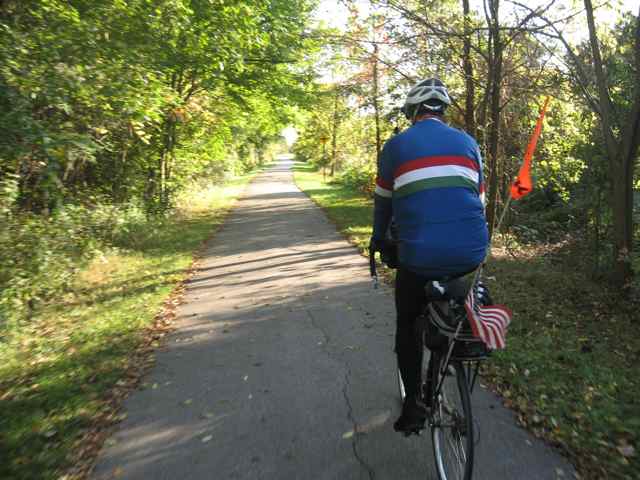
The Root River is a shallow, clear stream with a silt bottom. Its valley has carved small, pretty limestone bluffs that offer some elevation change, which is a big deal in Minnesota. The trail is over 40 miles long and is paved throughout, with handsome bridges every so often and occasional stops in small towns that range from completely tarted up to recently rebuilt. It was our first day of cycling through

deciduous woods, after weeks of ranchland and cultivated fields, and the weather was beautiful. The woods looked similar to the Finger Lakes, and it was surprising to see how fast the leaves had turned. It was warm and sunny, and we reveled in the smell and crunch of dry leaves under our tires. It was especially fine to have no cars in sight. It felt like a day off.
We met lots of attractive retired couples riding tandem recumbent bicycles they had rented in Lanesboro. The bikes took up almost the whole eight-foot strip of pavement. Jim and I zipped past them like bike-path pirates, pumping away. Golden light was reflected through the leaves. It felt like we were crashing a commercial for erectile disfunction pills. As I crept up on the unsuspecting 60-ish couples, I had this thought: when the moment arrives, will you be ready?

We stopped for lunch in Lanesboro. The counter man told us that in 1980 you could have bought the entire town for $25,000. Today it has been completely resuscitated, thanks to the bike path and the discretionary spending of southern Minnesota’s retirees. I found a German deli and had an excellent braunschweiger sandwich with onions, mayo, and homemade mustard on German rye, along with coleslaw and homemade root beer. Back on the road, we scattered a pack of blue-shirted retirees who were happily chugging away on mountain bikes. Their shirts identified them as the “health angels.” One of the guys almost rode into us before he veered to the side. “Sorry,” said an older woman. “I didn’t yell at him.”

“Only in Minnesota would people actually wear shirts like that,” said Jim.

After an hour, we stopped in Peterson so that Jim could get a milkshake at Judy’s Café. I didn’t need anything, so I hung out near the front door and read the items posted there. I saw this poem and photo:
“On the 6th of March in two thousand seven,
The table of knowledge met,
With Bertram, Percy, Allen and Joe,
The big problems were no sweat,
Of course we met at Judy’s café,
A super good place to eat,
We had coffee, cookies, a short stack and eggs,
The food here just can’t be beat.”

The photo of the Table of Knowledge was perfect. If you looked up “small town diner” in the dictionary, this photo would probably be next to the definition.

Jim and I needed to settle our dispute, so after another picturesque half-hour of riding we pulled into the gleaming new Nordic Lanes in Rushford to bowl one game. I went first, and neither of us did well. I got a spare in the fifth and nine on my first roll in the sixth, and it looked as if my boast would come true. At the end of six frames, I had a whopping 62 to Jim’s 41. But Jim came roaring back with a strike in the seventh, and in the eighth frame I fell apart with a gutter ball and just one pin on my second roll. In the ninth and tenth frames I put the ball solidly in the pocket, and each time all the pins went down but one, which wobbled but stood. Some days you just don’t get the breaks. Final score: Jim 116, Brad 99. Until we meet again, Kersting.

Jim Kitchens, the owner of Nordic Lanes, explained that the building was new because the entire town of Rushford was submerged in August 2007. The area received 17 inches of rain over a weekend, and a usually tiny side creek flooded the town. About 370 buildings were damaged; many were completely destroyed. The town has been more or less completely rebuilt, thanks to a state flood relief bill. Jim Kitchens got a new bowling alley and restaurant, and he says that when al is said and done he will need to pay the state about $50,000. “It’s a different place, but business is back to where it was before the flood,” he said. We congratulated him, gathered up our things, and pushed on.

We saw an eastern hog-nosed snake sunning itself on the asphalt. When it sensed us, it raised its head up like a cobra; very impressive. A few miles down the road, Jim said, “Hey, isn’t that the bowling alley guy?” It was. “This is going to sound crazy,” he said, “but I think one of you took my wallet.” It was my mistake. Jim Kitchen’s wallet and mine were exact look-alikes, and I had put both of them in my bike bag. I melted into a grease spot with embarrassment and was preparing to get yelled at or punched, but he was Minnesota Nice about it to the core. “I could tell you guys weren’t thieves,” he said. “Have a good ride.”

We rode into Houston and camped at a municipally owned nature nenter at the eastern terminus of the trail. It had a huge, spiffy bathroom with a shower like you’d find at the Hilton. It was unbelievable but true that the whole center was supported by donations from riders and volunteers in Houston, which has fewer than 1,000 residents. Sometimes Minnesotans are just too good to be believed. I slept in a large new bandshell that the Lions Club had just completed. There was a marsh nearby, and the rhythmic chants of frogs and cicadas quickly put me in a deep sleep. Tomorrow we cross the Mississippi.

Categories
6. Wisconsin 7. Michigan Bicycling Across The USA

Wisconsin & Michigan, Sept. 26 to Oct. 4

michigan-wisconsin-c2c4We rode across the Mississippi River into LaCrosse, Wisconsin on Friday. September 26 and for the rest of the day we were on dedicated bicycle trails. We started with the Three Rivers Trail through the city, then rode on the LaCrosse River Trail to Sparta (parallel to State Route 21) , then on the Sparta-Elroy Trail to Elroy (parallel to route 71). On Saturday we continued east in the vicinity of State Routes 82 and 23 to Green Lake. Most of this day we were on county roads that ran parallel to the state highway. On Sunday we continued picking our way through county roads, staying near 23 until it reached U.S. Highway 151 at Fond du Lac (Lake Winnebago). We continued on 151 to the shore of Lake Michigan, and stayed in Manitowoc at the home of Michael Retzinger, his wife Amy Tiesol, and their daughter Ceci.

Monday the 29th was a rest day. We boarded the S.S. Badger car ferry in the afternoon and crossed Lake Michigan to Ludington, a five-hour trip. On Tuesday the 30th we began riding east through Michigan on county roads in the vicinity of U.S. Highway 10. Near Luther we picked up the Adventure Cycling Association’s “Lake Erie Connector” route. This kept us on blue highways that are near U.S. Route 10. We slept in the woods on Tuesday and in Midland on Wednesday. On Thursday we continued through Bay City and then zig-zagged southeast on state and county roads, staying in Caro. Friday, October 3 was the only 100-mile day of the trip: we passed through Brown City, Capac, and Memphis, and then picked up a bike trail along the St. Croix River at St. Clair that took us to a state park south of Marine City. We started through Ontario on on Saturday, October 4, after taking a ferry across the St. Claire River.

Categories
5. Iowa & Minnesota 6. Wisconsin Bicycling Across The USA

Days 46, 47, & 48: Houston,MN to Manitowoc, WI

Day 46: Houston, MN to Elroy, WI

I woke up in the new bandshell built by the Lions Club of Houston, Minnesota. The city park in this tiny hamlet (pop. 1,000) is better than you’ll find in many towns of 50,000. It has a walk-in campground for people riding the Root River Trail. It has a nature center that specializes in owls. It has bathrooms that are new and sparkling clean, with the cleaning done by volunteers. It has the bandshell, which meant that I didn’t have to set up my tent. Best of all, it is surrounded by a protected wetland packed with birds that call and chatter at high volume as soon as the sun comes up. It was a real find.

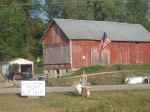
We left about 8:30am and cycled east on a county road next to the Root River. Fog was hanging in the valley and on top of the corn, but overhead the sky was blue. We went past the Mound Valley State Wildlife Area (more chattering birds) and noticed that the landscape was flattening out, the marshes getting bigger. We were getting close to the Mississippi River. At the intersection with Route 16, we saw a puzzling display. A female mannequin was ironing, and a girl mannequin was hanging onto her leg. An American flag on a bent pole was planted nearby. On the other side of the display was a sign that read “See George at Kwik Fill Hokah.”
“Maybe George is looking for a wife,” said Jim.

“She’d better be patriotic,” I said.

We crossed the Mississippi on U.S. 16 at La Crescent, dodging traffic and broken pavement and tire-eating garbage. There were several miles of marshes and industrial sites before the actual bridge and shipping channel, which was lined with houseboats and barges. Then we were in LaCrosse, Wisconsin. All props to the cheese-heads: we saw our first party even before we got off the bridge. Lining a street next to the river were seven or eight marching bands tuning up. A big parade was about to start, and it was going right along our route! It was awfully nice of them to go to all this trouble, but how did they know we were coming?

We rode through the waiting Oktoberfest kick-off parade and then rode down the street in front of all the people who were waiting to see the marching bands. We saw men wearing leiderhosen and women in milkmaid dresses. We saw beauty queens primping and climbing onto thrones on gussied-up flatbed trucks. We waved, and some of them waved back. “We have to keep moving, or we will be here all weekend,” I told Jim. He didn’t want to go. He wanted to stop and chat and have a beer at ten in the morning, and I knew that if he did he might wake up thirty years later wondering what happened. We were missing a giant blow-out, but duty called. We rode on to a pretty riverside park and a giant statue of Hiawatha. Then the bike paths began.

Wisconsin turned out to be paradise for bicycle riders. LaCrosse’s Three Rivers Trail immediately took us out of city traffic and through linear parks all the way to the outskirts of town. We turned east on the LaCrosse River State Trail and rode it for 22 miles, then finished the day by riding the length of the 32-mile Elroy-Sparta State Trail. It was an 80-mile day that felt like a vacation. The LaCrosse Trail is strung between an active rail line and Interstate 90, and we were entertained by scary Amtrak trains and freights barreling past on the other side of the ditch. It was hot, and our water bottles were nearing empty when we pulled into Sparta.

Sparta advertises itself as the Bicycling Capital of America because back in 1967, the abandoned railbed from Elroy to Sparta became the first “rail-trail” for hikers and cyclists. There are now thousands of miles of rail-trails in America. Governments pay for their development because this is a cheap way to preserve transportation corridors while pumping tourist dollars into rural areas. But the whole idea started here, and we watched a charming promotional movie made by locals in the late 1960s that featured two children lumbering along on single-speed bikes that looked like small tractors. Great oaks from tiny acorns grow.

Sparta’s tourism center lured us into the town because of the “Deke Slayton Memorial Space and Bicycle Museum.” I grew up in Florida in the 1960s and the late Deke Slayton, an A-list astronaut, was one of my big heroes. It turns out that he was a Sparta native. Jim took my picture posing with a life-sized sculpture of Deke, and then I went upstairs. I asked the woman at the gift shop, “Did Deke Slayton like bicycles?”

“Not especially,” she said.

“So what is the connection between bicycles and space travel?” I asked, hopefully. “Is there some connection?”

She seemed puzzled by the question. “Just that they’re both here in Sparta,” she said.

Sparta is kind of eccentric, and the weirdest thing about it is the larger than life sized sculpture of “Ben Bikin” in the city park. Ben is a fictional 1900s character with a handlebar mustache. He is astride an old “boneshaker” big-wheeled bike. He is perhaps 25 feet tall. There is a hidden motion detector in the base of his statue, and when you approach he will suddenly shout “Hi! Welcome to Sparta!” and then tell you how great everything is here. It was startling, cheesy, and funny. It was the kind of moment you live for.

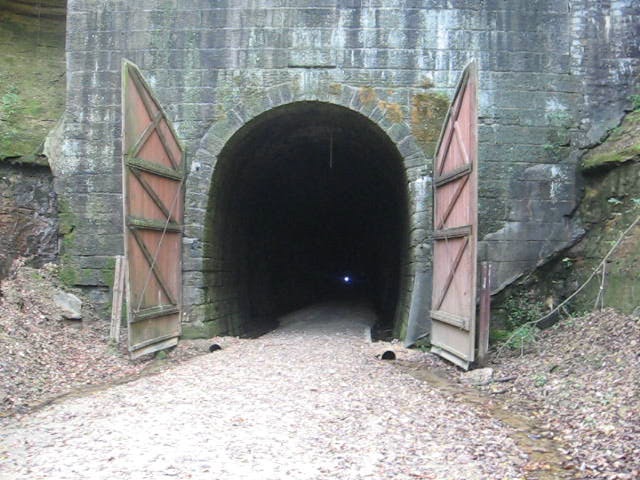
The Elroy-Sparta line was the main rail route between St. Paul and Chicago in the early part of the 20th century. The nearby highway was also an old tourist route for automobiles, and the locals have carefully preserved a lot of the architecture and signs from 80 years ago. Western Wisconsin’s hills are glacial, meaning they are short but steep, so the line is distinguished by three tunnels so long that they require headlamps. Jim and I were as excited as children by the prospect of riding through these tunnels, which lived up to their spooky billing. Riding through them was an experience of total darkness on either side, the sound of dripping water, and a pinpoint of light in the far distance. We weren’t supposed to ride through them, but of course we did. We even made movies of each other riding through them. That is why we wear helmets. We’re idiots.

By the end of the third tunnel we were exhausted, and Jim had a slow leak in his front tire. My wife Tania had flown out for the weekend, cashing in the rest of her frequent flyer miles, and she had found a motel for us that was clean and comfy and quiet. Seeing her at the end of a day like this made it all feel just about perfect.

Jim and Sara stayed at a campground; Tania and I went into Elroy, a charming village that city people have not discovered yet. We found a diner along main street that was serving dinner. It was Friday, everyone was having the fish fry, and the place was packed. Then we went back to the room and watched Barack Obama debate John McCain. That doesn’t sound very romantic, I know, but we made it work.

Day 47: Elroy to Green Lake, WI
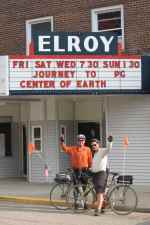
Tania and I met Sara and Jim at a coffee shop on Elroy’s main street. We set off around 9:30 am on Saturday, September 27. We were on county roads and were headed to Green Lake, where we had been told there was a “harvest festival” and a parade scheduled for 4pm. We had about 80 miles to go, but it remained warm and sunny, and there was a slight tailwind. This and the parade deadline kept us pumping along at top speed all day. We averaged more than 15 miles an hour and did the mileage in a bit over 5 hours in the saddle, with 90 minutes of rest. It was our fastest ride ever.

Wisconsin’s county roads are all paved, so there are dozens of low-traffic ways to get from one small town to another. We cycled through hills and dales that looked like the glaciers had missed them, pausing briefly when a bird or a snake or a notable barn caught someone’s attention. We spent several hours pedaling in a pleasant but uneventful way, until out of nowhere a handsome art deco stone-and-steel sign for the Oxford Federal Correctional Institute came up on our left. We stopped to admire the careful landscaping and big close-cropped lawn around the sign. Then we noticed two little girls who had come out of a house trailer across the street. They sat cross-legged on the lawn and faced us, while a man who looked like their father stood behind them on the stoop.

Jim fell into a conversation with the man, as he always does, and the girls lobbed questions at us simultaneously without waiting for the men to stop talking. Jim wanted to know about the prison. The man wanted to know about our route and what we’d seen. The girls wanted to know whether we always wore our helmets and whether either of us had been hit by a car yet. I told them yes and no, and that they should always wear their helmets too. Jim said entertaining things to the man, and in return he found out that it was a minimum security prison “for crooked judges and Congressmen.” This might be why we saw several European sports cars turning into the gate, and also why I heard a sound from behind the hedge that sounded an awful lot like people playing tennis.

“They got it real nice in there,” said the man. “They got sports and a swimming pool. On Memorial Day they even had a live band. They got it better than we do out here.”

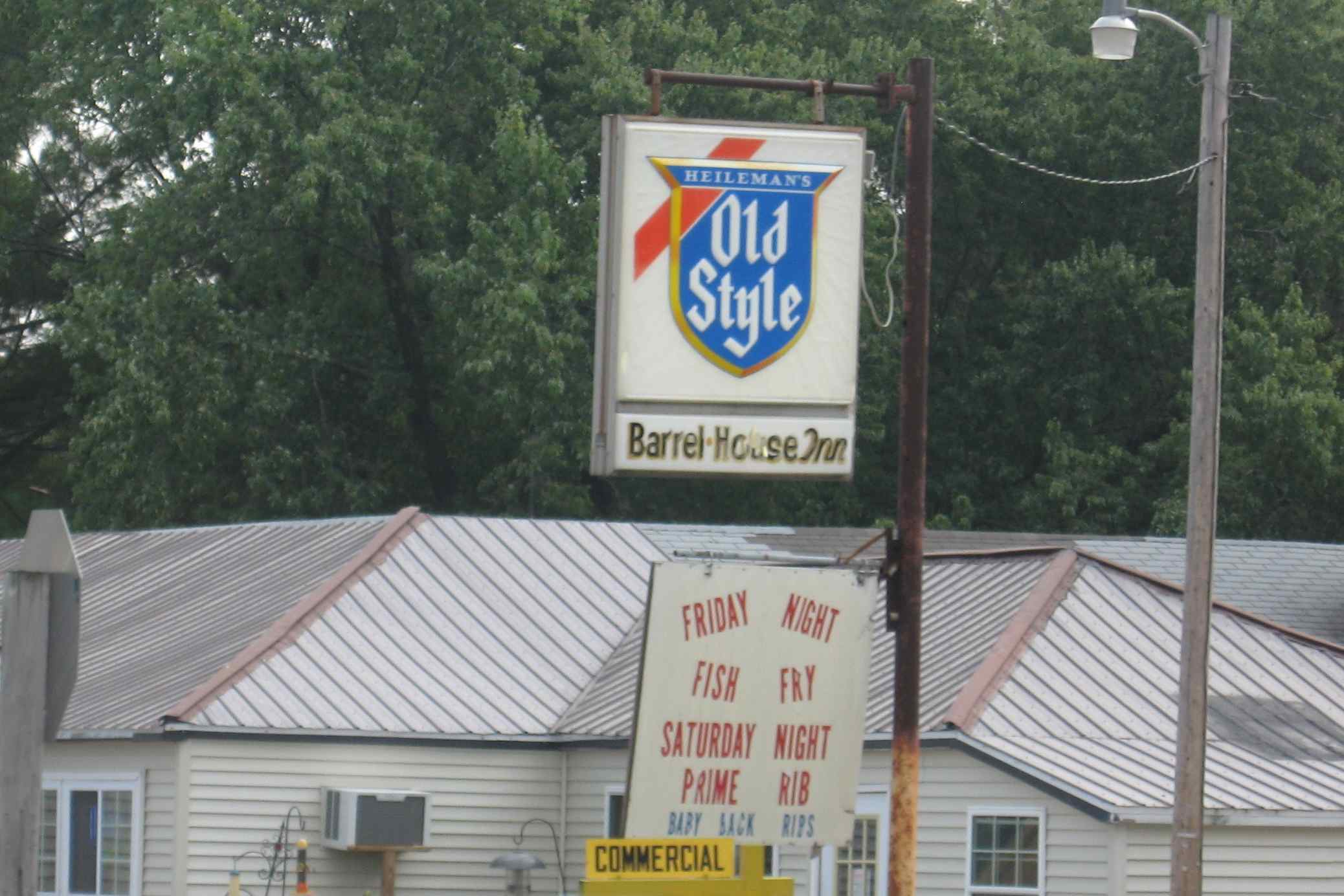
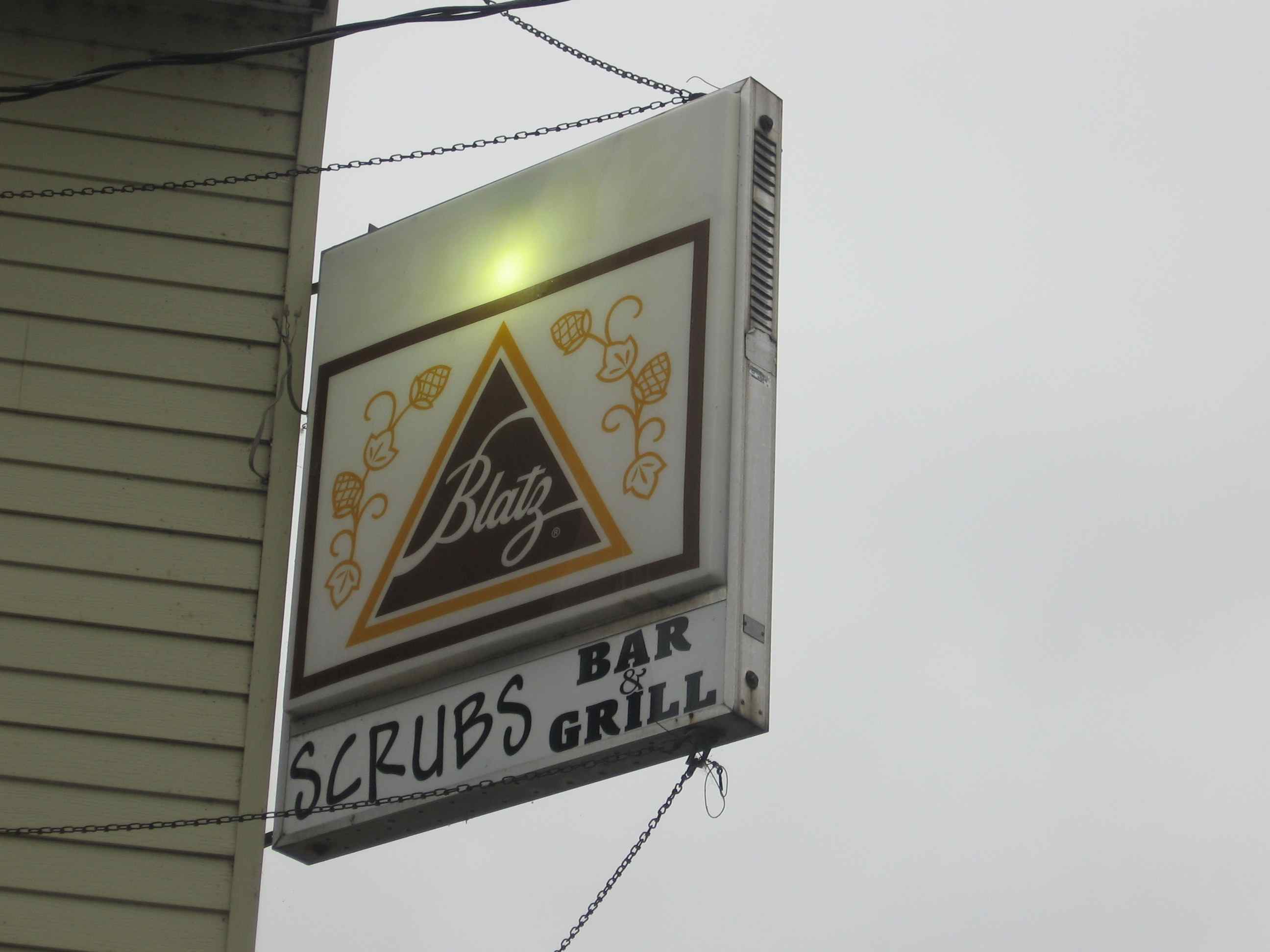
Riding as hard as we were did not give us much time to stop and check things out, but I did hear and see evidence that Wisconsin is the undisputed alcohol and cholesterol capital of the country. “You have no idea,” said the woman who served us breakfast. “If you want to know, go down to the Sportsman’s Bar tomorrow, get an Old Style and some deep-fried cheese curds, and stay until kickoff. You’ll see some stuff, for sure.” I had to take her word for it, which pained me greatly. But I did see that every little hamlet had a beat-up plastic sign for Grain Belt or Old Style or Blatz or Pabst Blue Ribbon Beer hanging in front of an equally beat-up building, and there were usually lots of beat-up cars parked out in front. We also rode past two American Legion Brat Fry fundraisers. That’s bratwurst for the noviates, or mildly spicy German sausage on a roll. It tastes way too good for your own good. We ate a lot of brats on the ride. They were cheap, easy to cook, and very tasty. When I got back home, I found to my horror that my total cholesterol number had actually increased.

It might sound improbable that a milkshake is the best thing to order for lunch while you’re on a long ride, but we had been told this by several athletes and we were happy to believe it. In fact, I became convinced that this was the real reason Jim rode across the country. Tipped off by Tania, who was buzzing around us all day in an electric blue rental car, we stopped in Westfield and got two excellent shakes at a candy store that also sold wooden replicas of guns and swords for the kids to play with. These were the kind of things that get kids shot by cops in the Bronx, but in Wisconsin they’re just cute. Lawn signs for John McCain outnumbered Obama signs in this town by about three to one.

A milkshake hits a touring cyclist’s system like a tank of high-octane fuel. It and the tailwind and the 4pm parade deadline juiced our legs and we screamed through the last 20 miles of the trip in an hour. The nice motel room Tania had picked out might have had something to do with it, too.

Green Lake is an affluent resort town that still retains its Wisconsin party flavor. We got to town just as the parade was starting. It was a sublime and wonderful spectacle, and totally free of irony. A tractor pulled small children who were piloting hollowed-out barrels that had been painted to look like airplanes. A delighted boy rode a real camel that announced the first contingent of Fez-topped Shriners on tiny motorcycles. A float for John McCain floated by and everyone ignored it. Tania got her picture taken with a walking ice cream cone advertising Culvers’ famous “butter burgers.” The young woman inside the cone explained that these are, indeed, buttered hamburgers (see cholesterol comment above). There were also lots of fire trucks with flashing lights and dump trucks that blasted their air horns, scaring everybody. But the highlight of the parade, for me at least, was the second contingent of Shriners, who sped around in circles inside tiny cars.
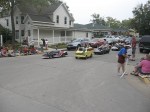
What a mystery Shriners are. Why do they wear hats from Morocco? They have so many different symbols on their hats. What do they all mean? And who got the idea of stuffing these huge men into go-carts? After I made the blog post, Diane Ihle answered these questions by writing, “What’s the mystery? Men never grow up!”

Tania and I retired to the Bay View Motel after the parade. It was also a find. It seemed to be built in the early 1960s and it retained the original Swedish blond wood paneling, pink and green tiled bathroom, and oversized shower. It also had a lawn next to the lake, where Jim and Sara joined us for happy hour. We went to a jammed restaurant and made to bed by 10 pm, which was about an hour too late for us old folks.

Day 48: Green Lake to Manitowoc

We set off for Manitowoc on Sunday around 10:00 am after saying goodbye to Tania, who had to get back to Ithaca. We had another 80 miles to go before our destination. Manitowoc is about 90 miles north of Milwaukee on Lake Michigan. It is where you board the S.S. Badger, the ferryboat we used to get to the next state while avoiding Chicago’s sprawl.
The weather had turned overnight, so we set off under gray skies, a north wind, and temperatures struggling to hit 60 degrees. We pushed to reach 13 miles an hour against crosswinds and headwinds, and had a lot less fun. The first 20 miles were on busy highways with bad pavement and no shoulder. Then Jim, whose route planning skills never fail to amaze me, found a bike path that would take us through Fond Du Lac. This got us off the roads for several hours. He couldn’t get rid of the wind, however.
The traffic thinned out north of Fond Du Lac, and the last 50 miles of the ride was an uneventful slog through county roads that would have been beautiful had we not been cold and exhausted. I only collected a few things to report. First, this was Amish country. Several times we met or rode past black horse-drawn carts heading home from church, or to
Sunday supper. Hands waved back to us from behind tinted glass, and then they were gone. Second, in the tiny hamlet of St. Anna we rode past the Scrubs Tavern. The parking lot was full of cars, so many of them that it seemed everybody from miles around had to have been there. A roar came from inside the bar. The Packers were playing.

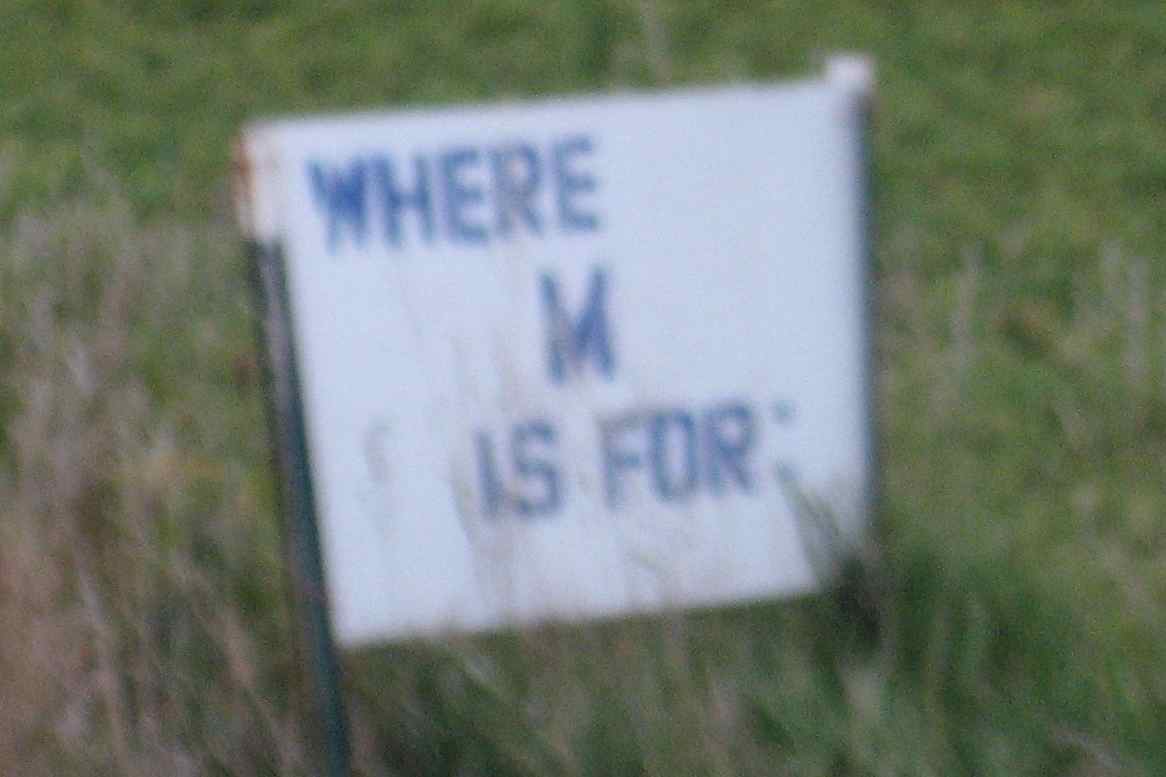
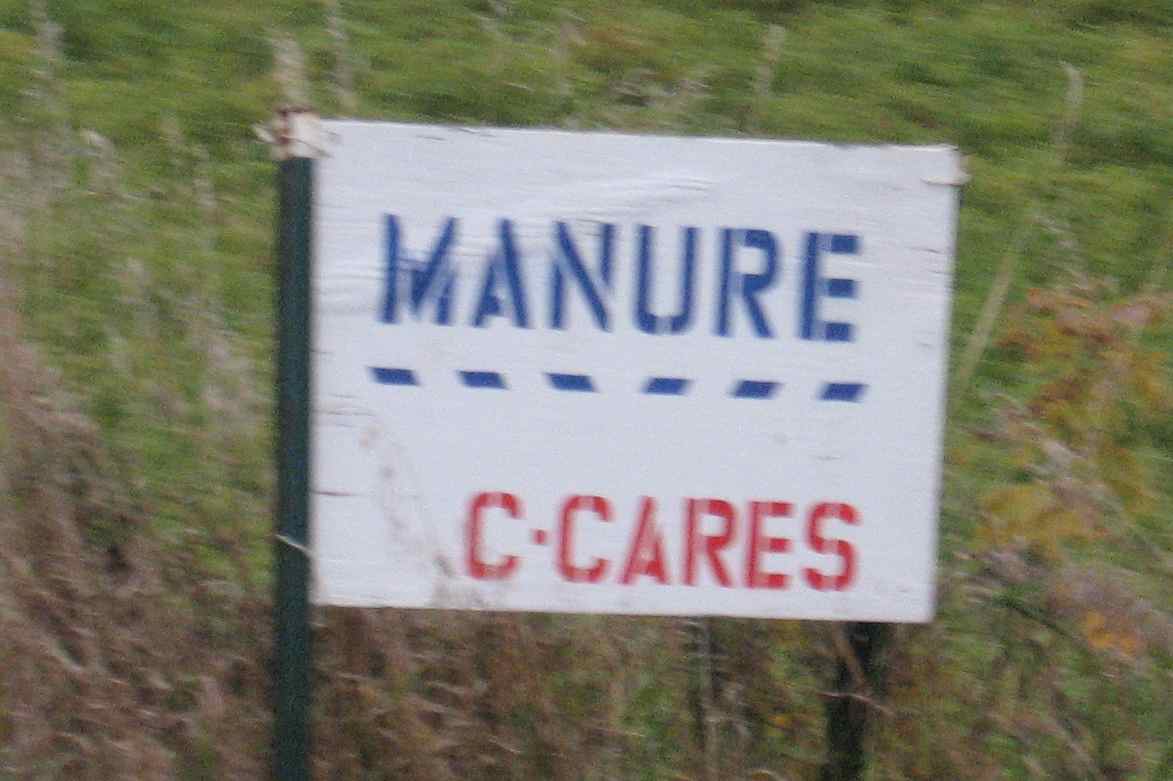
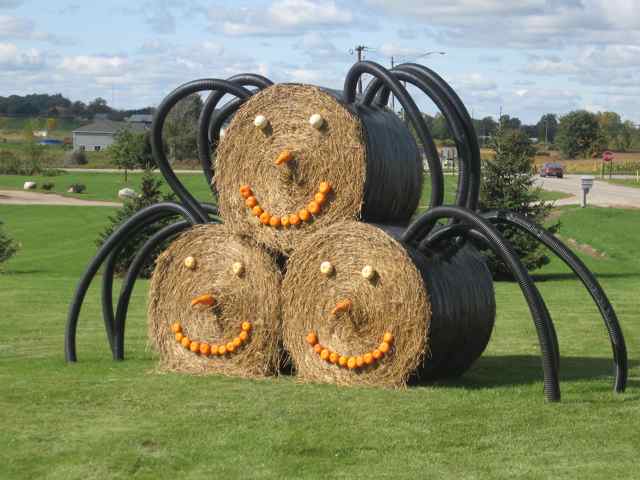
We rode east to the Manitowoc County line through big dairy farms that smelled like poop. One farmer made a joke about it (see photos). We crossed Interstate 43 and suddenly there was Lake Michigan, and it was impossible not to think that it looked exactly like the sea. We turned north on the lakeshore and started on the last leg to Manitowoc. We almost made it, but in the overcast the light started fading around 6pm and Jim called Sara for relief. The truck showed up about ten miles south of our destination. We drove to the home of Bill Yust’s brother-in-law Michael Retzinger, his wife Amy Tiesol, and their daughter Ceci. Michael and Amy made us more than welcome, and nothing could have kept me awake after 10pm. It had been six hard days in a row. Tomorrow is a day for rest and adventure, including a four-hour ferry ride across the lake.

Categories
7. Michigan Bicycling Across The USA

Days 49, 50, & 51: SS Badger to Midland, MI

Day 49: Aboard the S.S. Badger

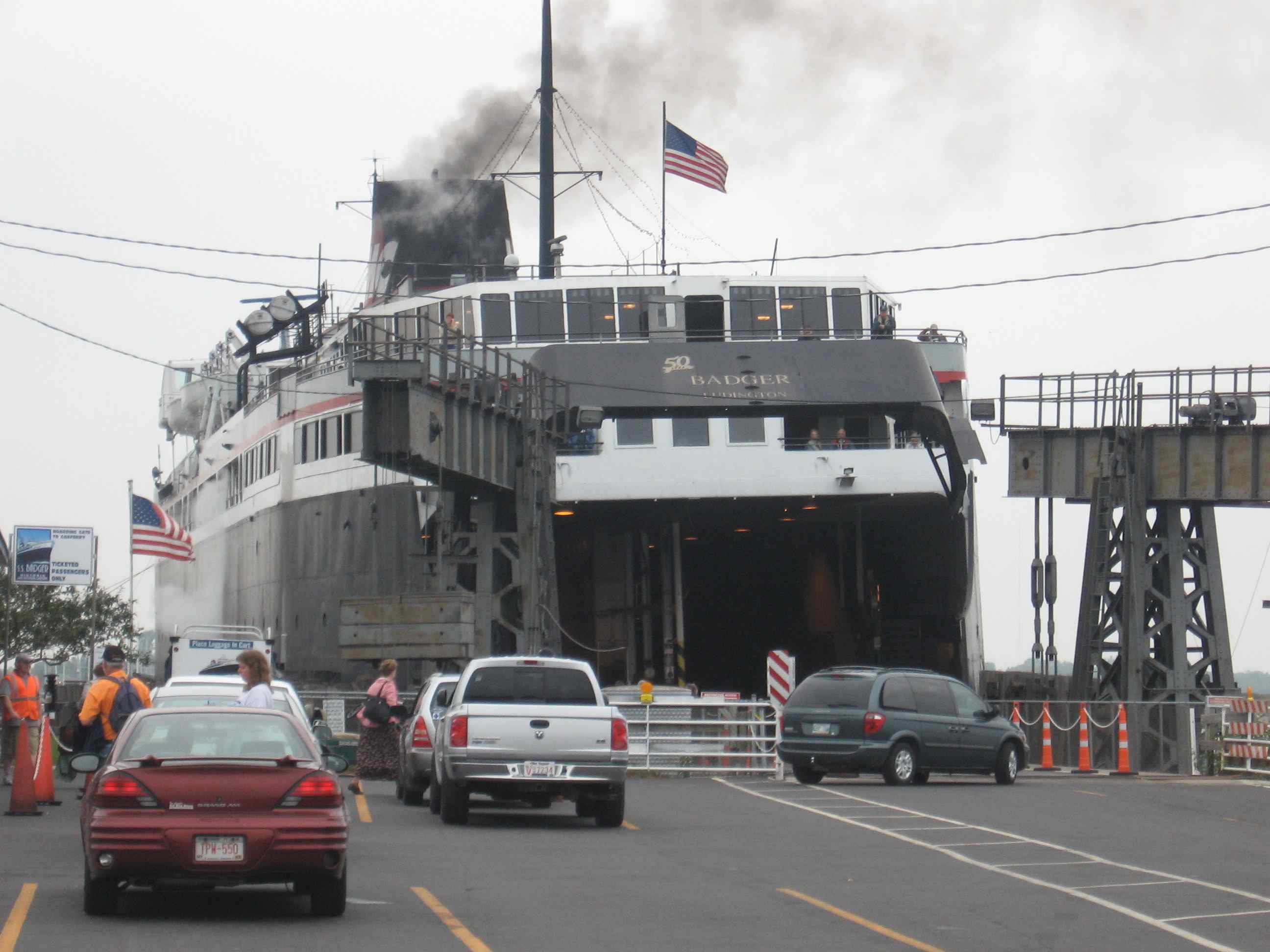
We boarded the S.S. Badger at 1pm and set sail for Ludington at 2. That gave us the morning to visit with our hostess Amy and her daughter Ceci, do laundry, and make a blog post. Then we clamped our biked onto the camper and went into Manitowoc.  I got an outstanding massage from Bobbi Totten at Bay Bodyworks. Jim and Sara shopped, and Jim thoughtfully bought me a small bowling trophy so I wouldn’t feel so bad about losing back in Rushford (see Day 45). We met for lunch at Beerntsen’s, an amazing candy shop with an interior that has been largely unchanged since it opened in 1932. Then Jim gave the car keys to an S.S. Badger staffer who drove the camper into the hold of the ship, and we got on board.

The Badger is the last surviving coal-fired passenger steamship in the world. It is 410 feet long, with two decks for passengers and one for cars. It has been sailing between Manitowoc and Ludington, Michigan since 1953, and is the sole surviving Great Lakes auto ferry from the pre-Interstate era. It can carry 620 passengers and 180 vehicles. The passage was not cheap ($65 a head, with an extra $100 for the car) but it saved us two days of driving and maybe two weeks of bicycling.

We were fortunate to cross on a calm day. There was no land in sight for three of the four hours we were en route. Had the waves been any larger, Jim and I would have been hanging over the rail.

The ship is listed on the National Register of Historic Places and is an important engineering landmark. In its heyday it was like a floating resort, with a full kitchen, dancing, and staterooms (which are still rentable). But although it is historically impressive, what impressed me the most was Badger Bingo. Jim took a seat near the stern, gulped fresh air, and worked on trip planning. I set up my computer in the Portside Bar, which was half-full of passengers. A couple sat down at the table directly in front of me. Both of them were at least 100 pounds overweight. Others in the lounge were even heavier. Several couples were in their 80s or older. These were the best-dressed people on the ship.

The overweight woman walked over to the bar while the man sat staring at the table. When she came back she said, “We have a serious problem. They don’t have bottles and they don’t have draft.” She put two cans of Miller on the table and he opened one without responding. After a few minutes, the man broke out a cribbage board and they started to play. The couple seemed content with each other, maybe even happy, although their speech tones were flat and they made no public displays of affection. After a while, a third member of their party appeared: a woman in a powder-blue tracksuit with stringy hair piled on top of her head. She took the couple’s picture. She was excited. “You’re nice and warm but I’m freezing up on the deck,” she said. “It’s raining, too.” The man grunted with what seemed like pleasure. The woman turned to Sara and said, “It’s our first time. We’re from Missouri.”

A staffer handed out bingo cards. He then took a microphone at the front of the lounge and began calling bingo games. He worked the crowd as well as he could, but told jokes so terrible I can’t repeat them — not because they were obscene, but because they were too lame. OK, here’s just one. A skeleton walks into a bar and orders a pitcher of beer and a mop. See, I told you.
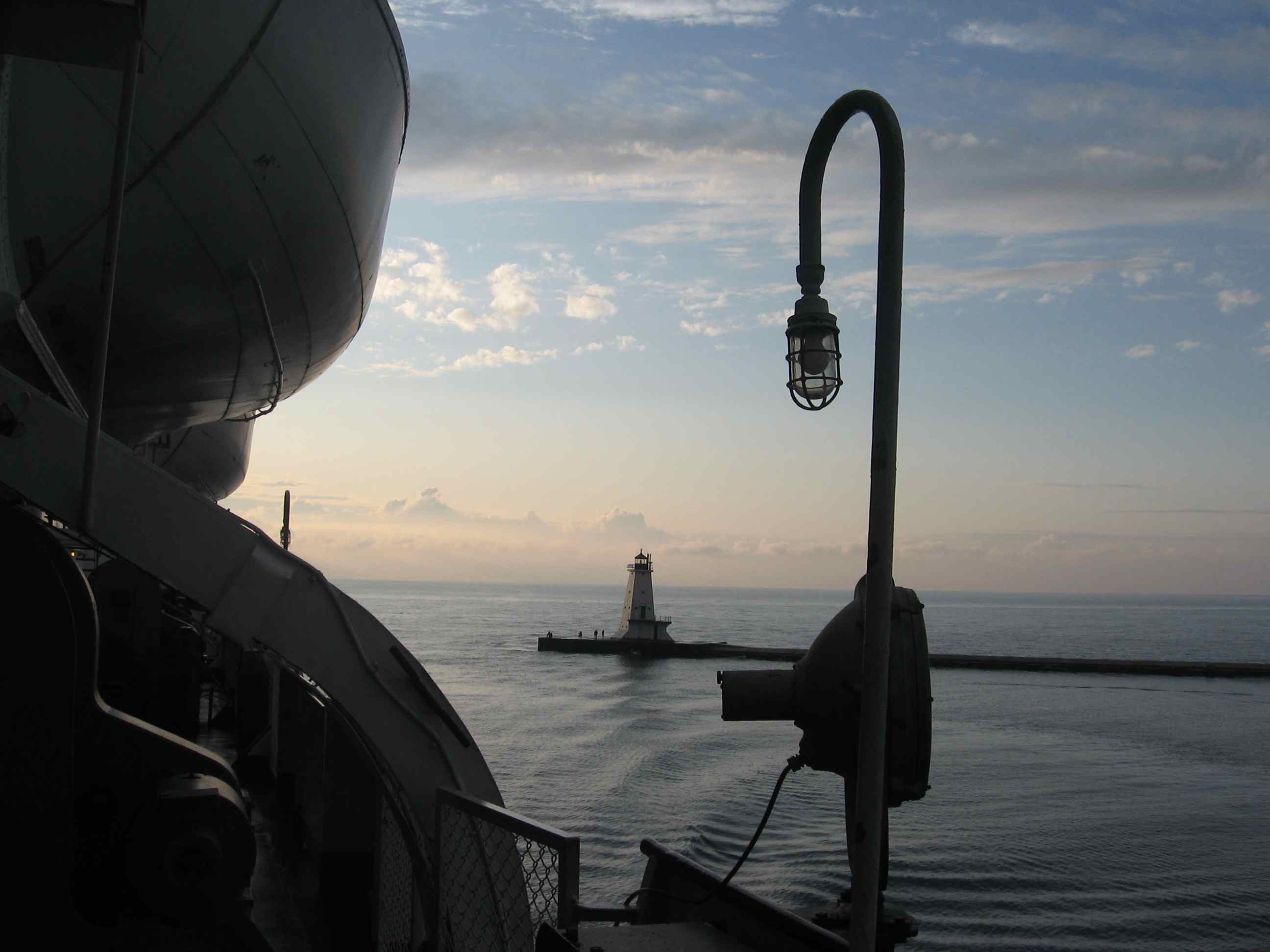
Fox News was on in the next room, reporting that the House of Representatives had just voted down the financial bailout package and that the Dow Jones Industrial Average was down 800 points. This didn’t cause a ripple in the lounge. The tracksuit woman returned to the couple again. The woman greeted her and said, “Did you hear?” I thought, Wow, somehow she’s heard the news and she understands it, too. Then she said, “I won the pizza!”

If this had been the Long Island Railroad, the bar car would have been a funeral. But out here on Lake Michigan, between Manitowoc and Ludington, the unveiling of a global bank collapse didn’t seem to have much to do with anyone’s real life. When the recession hits them, the couple from Missouri might have a vague notion that crooks in Washington and New York caused the pain they’re experiencing.  They would be right, of course, but I don’t think they’ll connect the dots and take action to stop it from happening again.  I hope I’m wrong.

The ferry docked at 7pm, having taken us from the Central to the Eastern time zone. We drove ten miles north to Ludington State Park, which is a stretch of large sand dunes and beautiful lakeshore. The forecast was for rain, and it was getting dark. We set up quickly and returned to Ludington for a fine Italian meal at the Luciano Ristoranti, then crawled into our beds just as the rain began to fall.

Day 50: Ludington to Lake Sunrise

Another day, another 75 miles. We woke up to a dramatic fall sky of white and gray clouds scudding across the lake front, and a north wind that had me digging for a sweater. The rain was supposed to continue all day, so we suited up in full regalia. We had detachable fenders, rain jackets, rain pants, tights, and neoprene booties. As it turned out, it only rained while we were inside a diner eating lunch. Otherwise, it was dry. Hey, you never know.
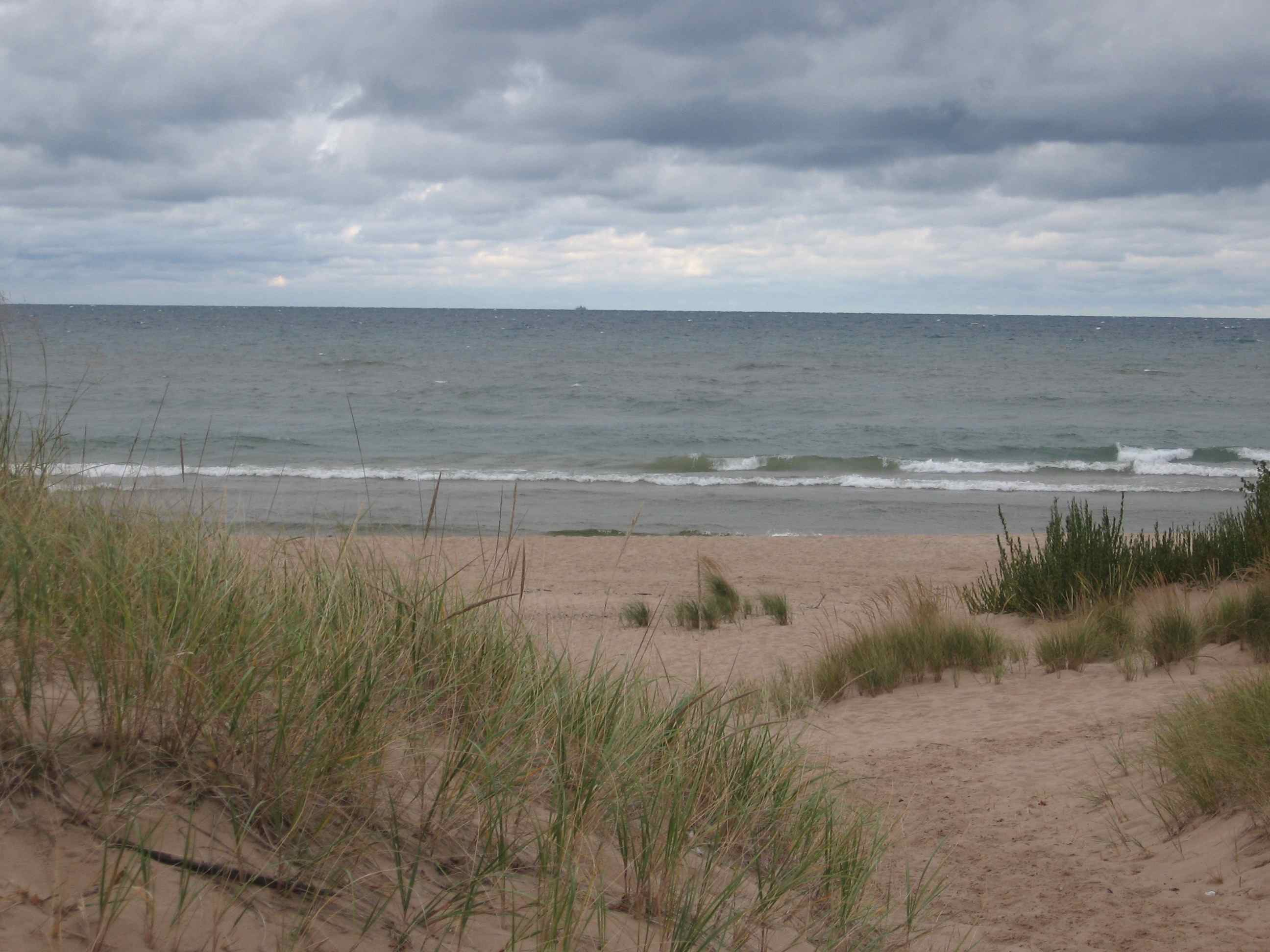
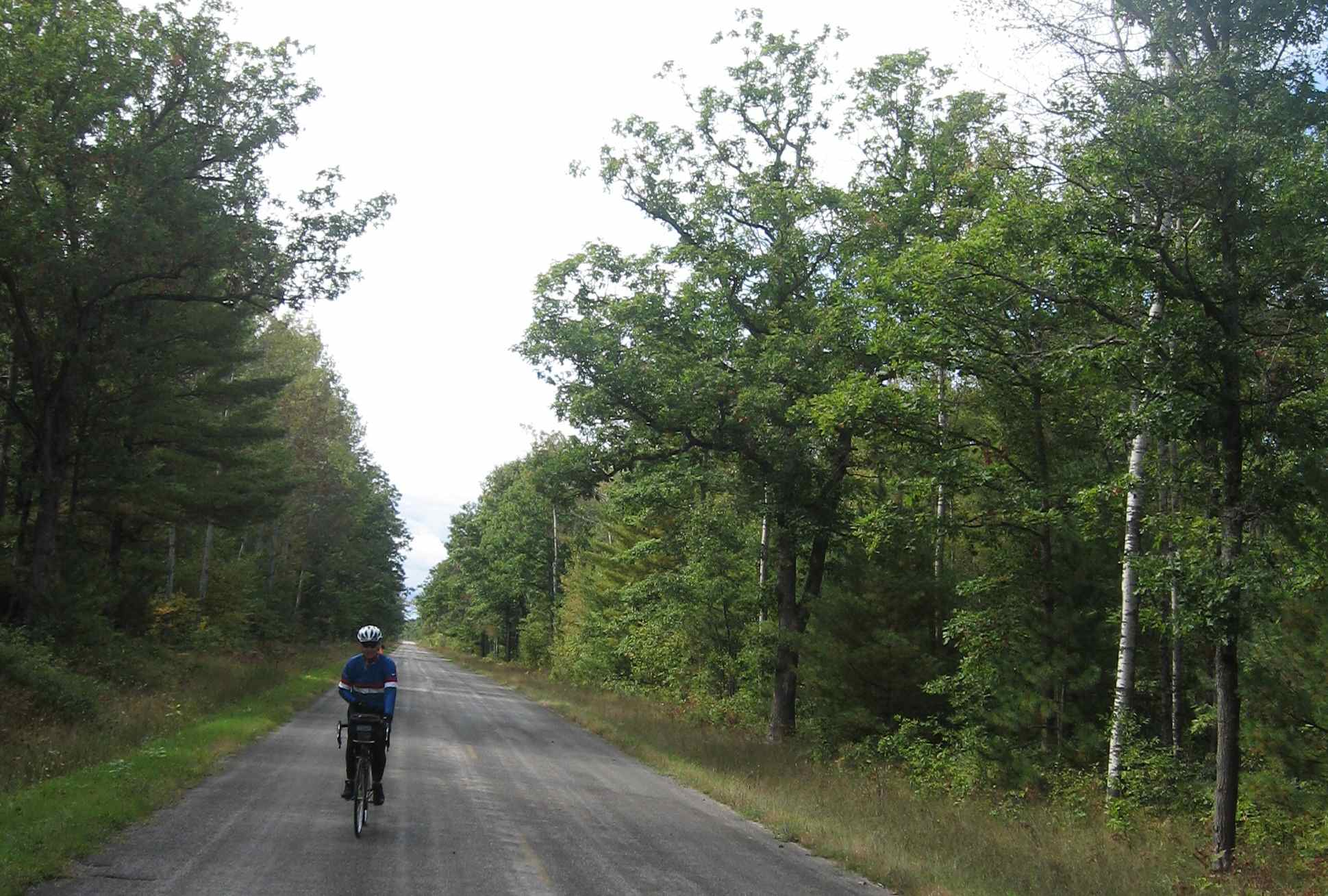
Salmon were running on the Big Sable river. We rode past trucks parked along the State Park road and saw men in hip waders where the river met the lake. We hoped to follow county roads eastward to the remote village of Luther, which for some reason is the starting point for the Adventure Cycling Association’s “Lake Erie Connector” route. We had several maps to depend on, but floods had washed out many of the county roads. We were also told that some of the roads that were supposed to be paved were actually soft dirt. We met the dirt roads after an hour, and rode for three miles on a surface that was a little better than beach sand – but not much.

It was an uneventful day. Upstate Michigan at the end of September looks and feels like early fall in the southern Adirondacks. The houses are modest but well kept, and they are spaced wide apart. The woods are second-growth but maturing, and there are a lots of small lakes and wetlands. Every so often there will be a general store or a bar and grill, usually near a lake. It went on like this all day.

We rode into Luther, the biggest town of the day because it had a grocery store and two cafes. We had a bowl of hamburger and mushroom soup, which was a lot better than it sounds, and turned in our mystery maps for the excellent Adventure Cycling map. If you’re considering a long-distance cycle tour, visit their web site and review their routes. We have followed the ACA’s instructions for hundreds of miles now, and they are almost always great. They make a touring cyclist’s life a lot easier. Twenty miles past Luther, the map lead us to a primitive campsite on Sunrise Lake, where we cooked steak and went to bed by 9pm.  We were headed another 80 miles the next day, to a camp in the big town of Midland.

Day 51: Luther to Midland

“This campsite isn’t so bad,” said Sara as we were packing up. “I mean, it’s cold, dark, and wet…”

“Filthy, too,” I said.

“Yes, and filthy,” she said. “But other than that it isn’t so bad.”

Michigan’s state parks and highways are in rough shape. It cost us $37 to stay at the State Park and $15 to stay at Sunrise Lake, which had no electricity, a hand pump for water, and a pit toilet you didn’t want to use. The pavement on Michigan roads was the worst we saw since Montana. It’s hard to blame a place for neglecting basic services when its economy is on fire. Still, the roads in many parts of rural Michigan were so bad that it was hard to get around.

We left at 9am with 80 miles before us to Midland, where we had located a “deluxe” RV park. About a half-hour into the ride, we turned onto a highway and asked for directions at the Country Kitchen Diner at the intersection of highways 61, 66, and 115. A plastic sign outside advertised a Sweet Roll and Coffee Special for $2.50. It had been a while since the last sweet roll. We went in.

The diner was full of locals who were talkative and friendly. It took a long time for the sweet rolls to come, and while we waited we talked to three asphalt truck drivers who had been given the day off because of the rain. “Season’s almost over,” one said. “I can’t wait.”

“What do you do for money in the winter?, I asked.

“Unemployment,” he said. “People here need to string three things together to get by, but in the winter there’s no alternative to going on unemployment.”

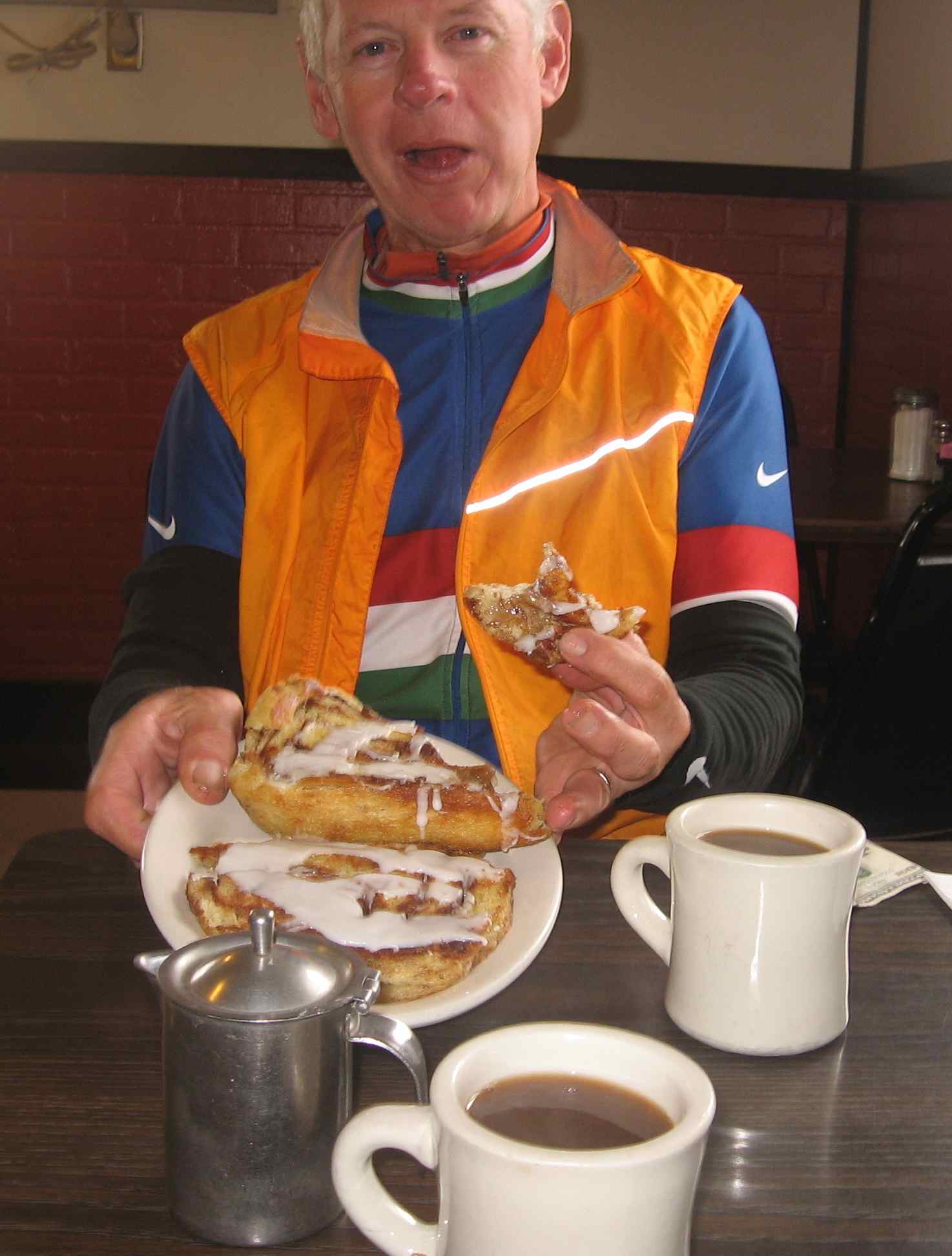
The sweet rolls arrived. Each one was as big as a hubcap. They had been split in the middle and fried in butter, then covered with hot frosting. “I can’t eat all of this,” said Jim, who quickly cleaned his plate. They were absolutely delicious, and they were also great fuel. We didn’t need lunch. That huge dose of fat and sugar stayed in our stomachs all day, burning as slow and steady as a big hickory log. We rode like banshees, again averaging 15 mph over the 80 miles.

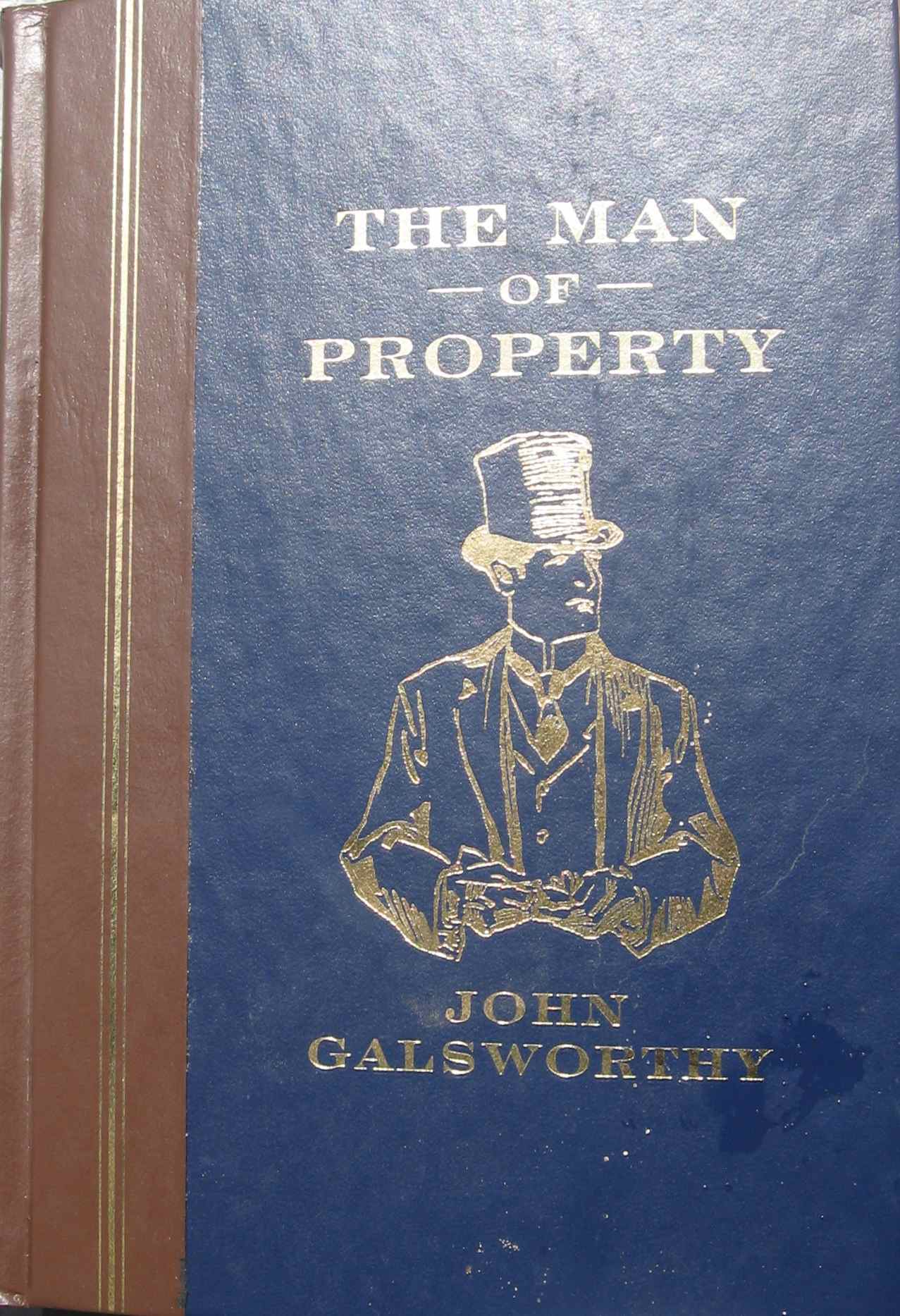
Soon after we left the diner, it was apparent that we had entered another area where impoverished people throw interesting stuff out of their car windows. Jim found a sparkplug remover for a chainsaw and spied two éclairs in a clear plastic container. I saw two books lying in a pile.  One was a paperback Readers Digest Condensed Books from 2007. The other was an unread hardbound copy of The Man Of Property, a 1906 satire of Victorian morals by the English writer John Galsworthy. It was also a Readers Digest product — one of those “classic” editions with a gold-embossed cover that is sold through the mail. I felt sorry for it and put it in my bag.

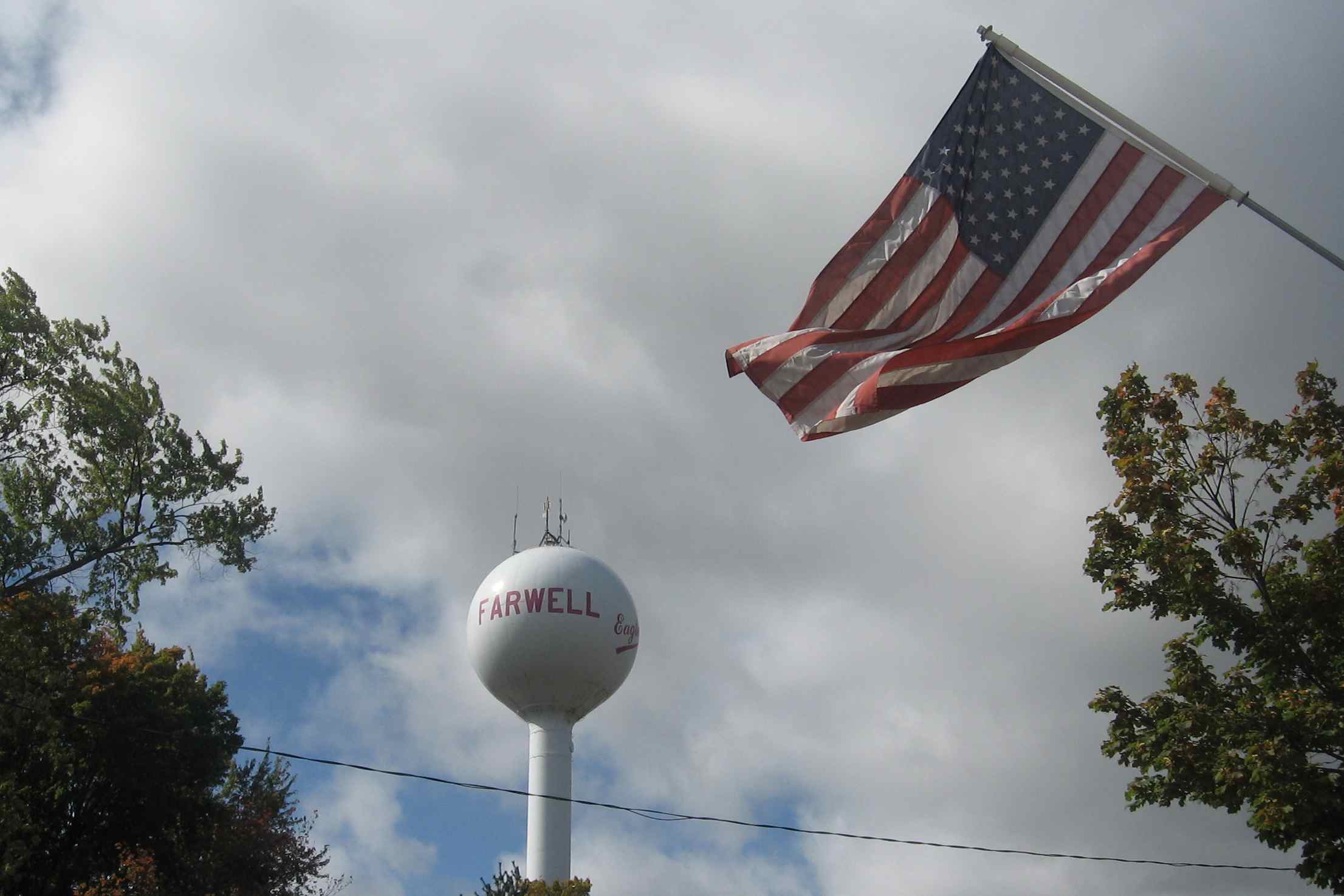
We rode through a bunch of roadhouse and gas-station towns and finally hit the town of Farwell, which was big enough to have a library. I went in, told my story to a young man at the desk named Philip, and gave him the book. “How disrespectful of them,” he said. “I’m sure we can use it.”

Small-town public libraries are consistently the most inspiring places I’ve seen on this trip. Even in places that are hurting badly, there is almost always someone behind the desk at the local library, serving people who still have ambition or imagination.

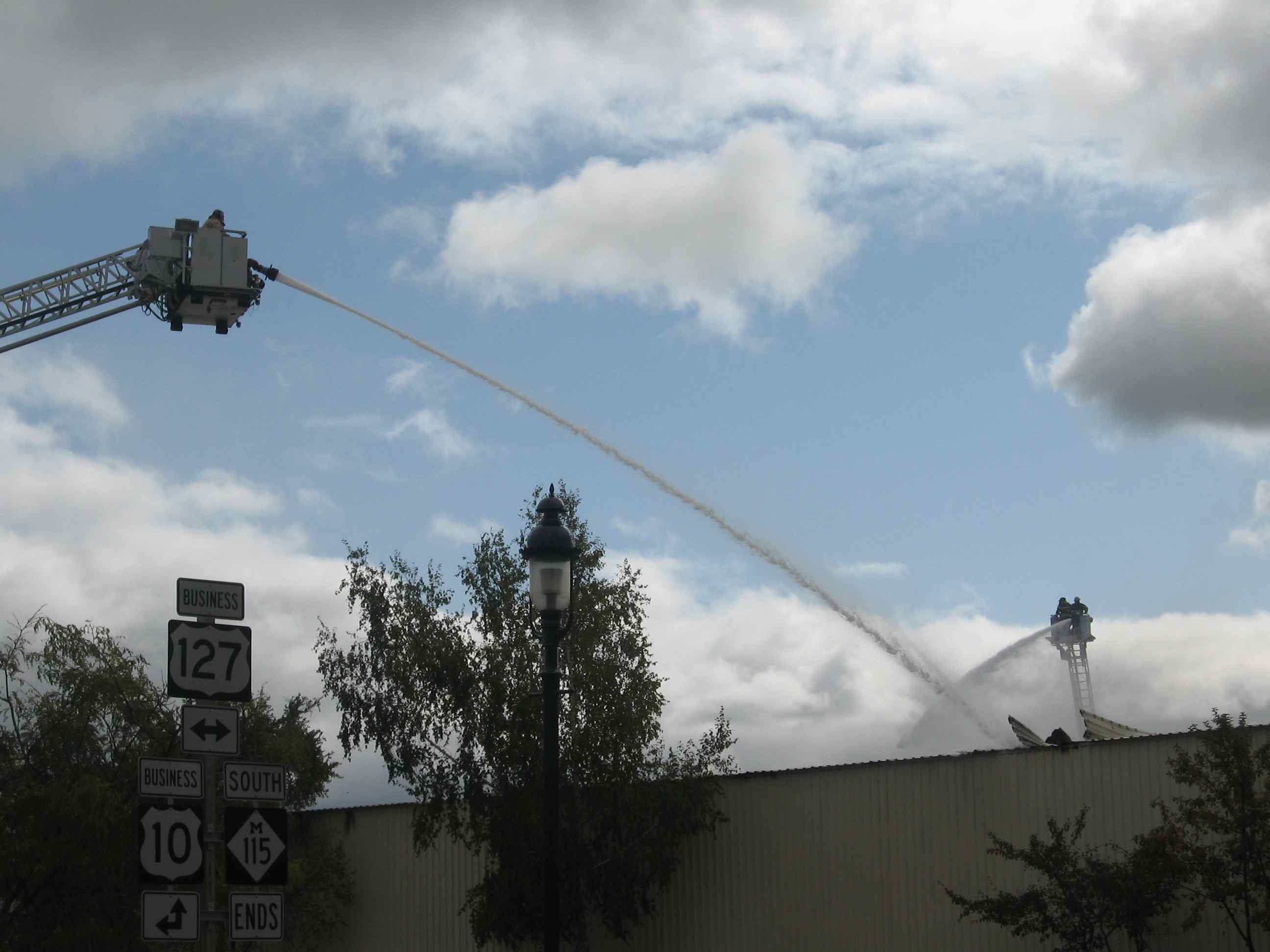
In the next town, Clare, there was a major fire going on downtown. An abandoned ice cream warehouse had gone up around 9am, and they had evacuated the city. We dodged the barricades and rode through deserted streets, ogling the big cherry-pickers spraying hundreds of gallons of water a minute. Everyone else was watching, too. It was a strange kind of festival.

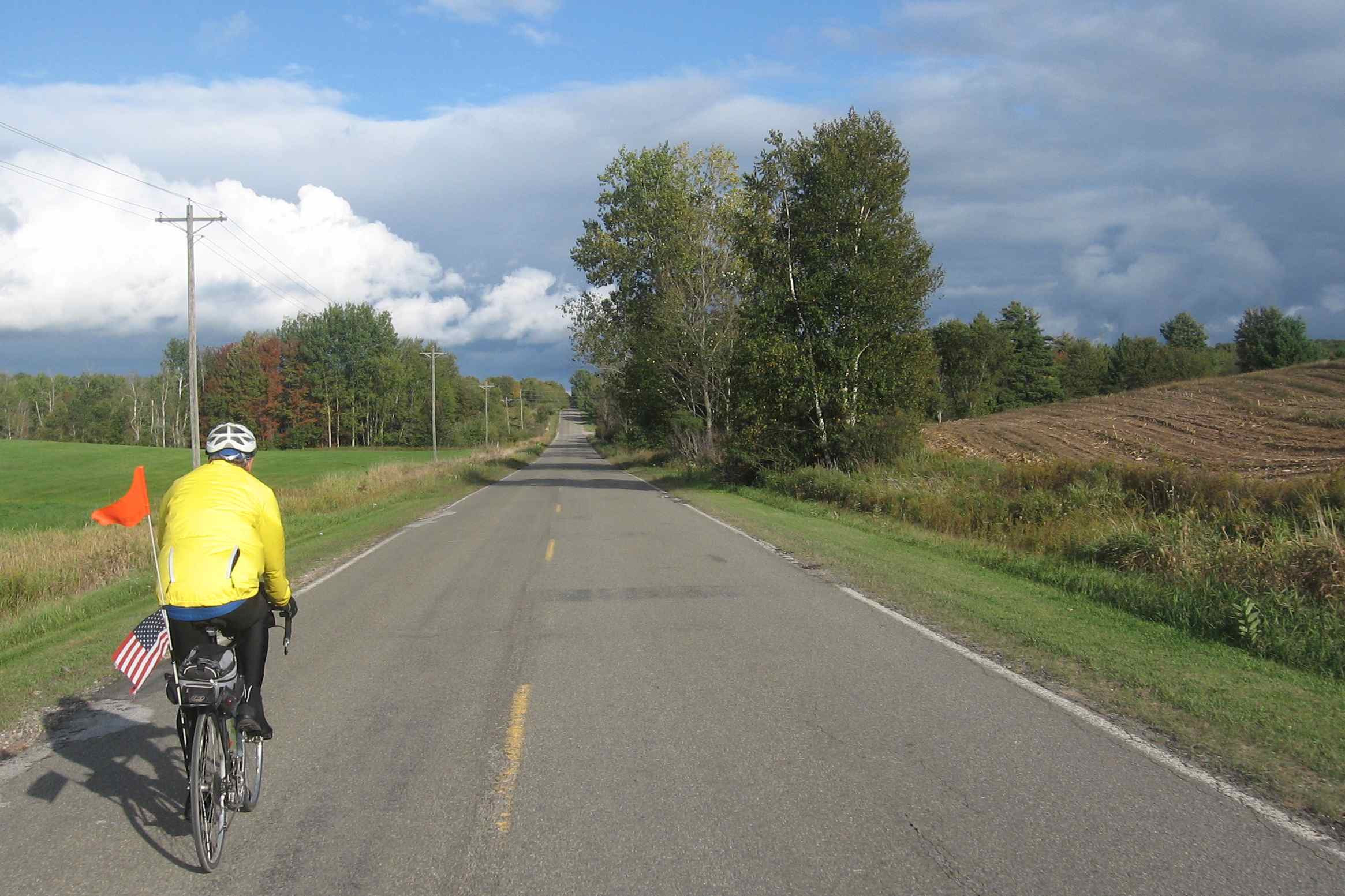
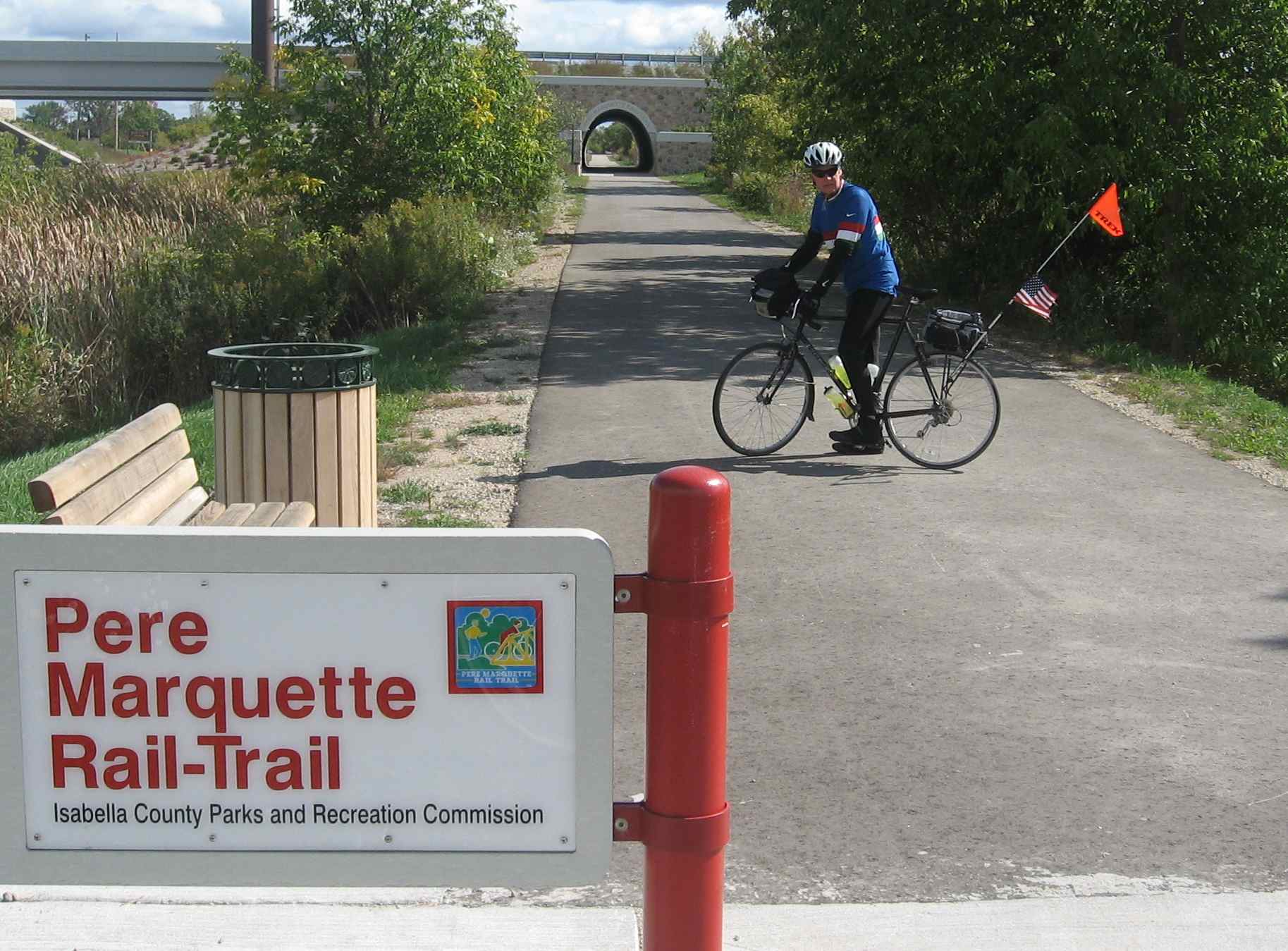
At the outskirts of town we reached the brand new Pere Marquette bike trail. It was perfectly flat, perfectly straight, perfectly paved, and it went on for 30 miles. Someone less hardened by bad pavement and 2,500 miles of pedaling might have found it boring, but Jim and I were delighted. It was like a speedway. We cranked our machines up to 22 miles and hour and kept them there, using up the last of the sweet roll energy and a favorable wind to push us along. Before long we were in Midland, the stately and well-planned home of Dow Chemical. We puzzled through the city’s bike path system and rode the last few miles to an RV Park that was connected to a deluxe health club and a Best Western hotel. It occurred to me that we started this trip all excited about seeing America’ beautiful parks and public lands, and now what really gets us excited is a TV lounge and a wireless internet connection. I felt guilty for a moment, but as soon as I got into the hot tub I forgot all about it.

Categories
7. Michigan Bicycling Across The USA

Day 52: Midland to Caro, MI

This was a short day with little in the way of scenery, lots of bad pavement, rude drivers, and a cold rain all afternoon. If Michigan could speak, it would be saying, “get the hell out of here.” But we did meet two very nice and somewhat wacky people.

We left Midland at 9am and were pushed out of town fast by a stiff west wind. Suburbs yielded to scattered rural sprawl on top of fertile cropland, and the further we got from town, the more farms we saw. We rode west and south through fields of beans, corn, tomatoes, pumpkins, potatoes, and sugar beets. Some of the houses had already put up Halloween decorations, and the weather was way into autumn.

When we got to Bay City, the Adventure Cycling map got too confusing and we got somewhat lost, which wasn’t good. We ended up riding on some busy city streets and fought off some of the most aggressive drivers we’ve encountered on the trip. We were passed too close, turned in front of, honked at, and stopped short, all in the space of about ten miles. Either Bay City was having a bad day, or every day there is bad.

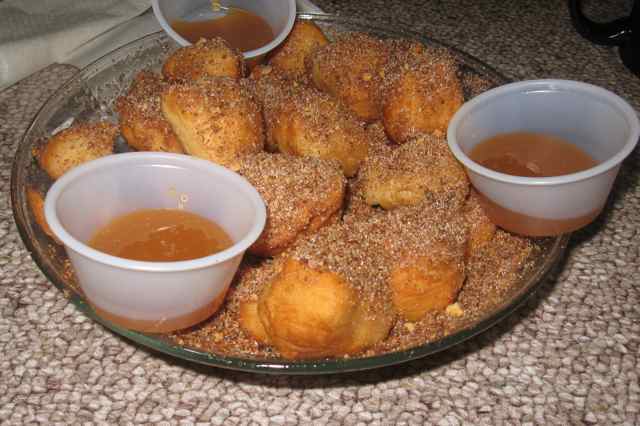
We rode for several hours through more farmland until we got to the small village of Fairgrove. Sara was waiting for us at Castamore Zangalotti’s Flashback Café, along with a table of 12 high school kids and several parties of old ladies. The food was great. Jim had a milkshake and grilled ham sandwich, Sara and I had chili, and for dessert we shared homemade cinnamon sugar donut holes, which are called “Martian Nuts” on the menu. “Ron was messing around with these for a church function, and someone who tasted them said they were out of this world,” said Jo Thomas, Ron’s wife and the waitress of the place. “One thing lead to another. Now there are a lot of jokes. Did you hear the Martians screaming out back after you ordered?”

Ron was in back cooking, and after the lunch crowd emptied out he came out to meet the cross-country riders. Castamore Zangalotti doesn’t exist, we learned. “I woke up from a dream and the name was in my head,” said Ron. “I wrote it down on a pad and went back to sleep. I checked Google, and didn’t find anyone who really has this name. But I couldn’t get it out of my head, so we named the restaurant for him.”

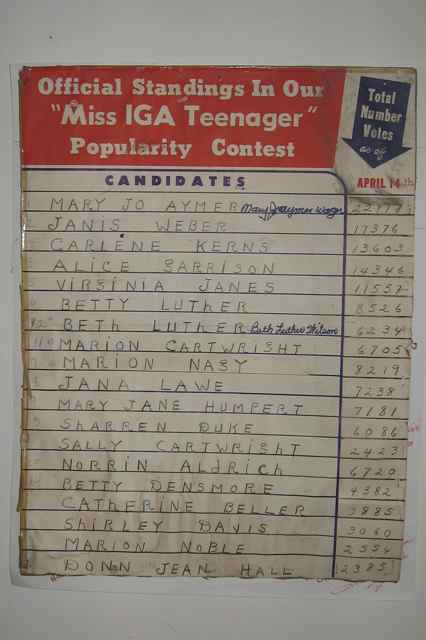
Ron and Jo were friendly and funny and not in a hurry. Their place is decorated with some great old weird stuff. They put a carpenter’s nail bag around the waist of a life-sized cardboard cutout of Elvis. There are lots of boosterish signs for the local high school football team (the Vikings), and just above our booth were the results of an actual popularity contest held by the village’s grocery store long ago. We didn’t want to leave, especially because it was starting to rain, but we still had the afternoon ahead of us, so off we went.

That was a mistake. The rain got worse as soon as we left town, and by the time we got to the next town, Caro, we were soaked. Having done 55 miles, we declared victory and checked into a motel. We wanted to watch the Biden-Palin debate, anyway.

I cleaned up and rode back into town, where I visited the local Democratic headquarters and got an Obama sticker for my bike.  Election season had finally caught up to us, and the news was good; that afternoon, the McCain campaign announced that they were pulling out of Michigan.  I told the woman at Obama headquarters this news.  She was so busy that it didn’t really sink in.

Later that evening, I was snoozing and trying to stay awake while Joe Biden and Sarah Palin jabbed at each other.  The cell phone rang. I picked it up and a deep, menacing female voice slurred, “I hate her.” It was Tania.  I love her.

Categories
7. Michigan 8. Ontario Bicycling Across The USA

Days 53 & 54: Caro, MI to Rondeau Park, ON

The rain stopped during the night and dawn came up clear and cold. We left the motel in Caro around 9am favored by a northwest wind, with a 100-mile expanse of farmland and small towns separating us from Ontario. We were following Adventure Cycling’s route, so most of the ride was on flat straight county roads with cultivated land on either side. There was not much to talk about and not many reasons to stop, although we did see some cool Halloween decorations. We rode 30 miles before our first stop in East Branch, where a young waitress with French braids served us cinnamon toast. The walls were covered with photos of another young woman who had reigned as a rodeo queen. The young waitress told us that the queen had moved away.

Two other towns we saw were also places where important things had happened long ago. In the small town of Brown City, Ray Frank got an idea while he was playing around in his garage fifty years ago. He welded a trailer onto a truck. Then he ignored the jeers of his neighbors, packed his family into the contraption, and drove it to Florida. It worked so well that his friends began asking him to make them one, too. He originally sold them as “Frank Motor Homes.” As business grew, the company was re-named Travco. Ray later sold a line of motor homes under then name Xplorer. Now it seems that every baby boomer wants a personal bus. Jim and Sara had me over for dinner in theirs every night.

Further down the line in the town of Memphis, we passed a historic marker with the headline, “The Thing.” It continued, “Thomas Clegg (1863-1939) and his English-born Father, John, built The Thing, the first recorded self-propelled vehicle in Michigan (and perhaps in the country), in 1884-85. The Thing, driven by a single cylinder steam engine with a tubular boiler carrier in the rear, seated four. The vehicle was built in the John Clegg & Son machine shop in Memphis. It ran about 500 miles before Clegg dismantled it and sold the engine to a creamery. The shop was razed in 1936, just before Henry Ford offered to buy it for Greenfield Village.” The backyard where The Thing emerged still has a few weird metal things in it, but no other signs.

Those crazy guys tinkering in their shops. What will they come up with next?

We had done 70 miles when we reached Memphis. It was 4pm, we had been averaging better than 14 miles an hour, and we still had some snap in our legs. We decided to go for a 100-mile day and end at Algonac State Park, near the ferry to Canada. The last 15 miles were on the Bridge To Bay rail trail, which runs along Lake Huron, the St. Clair River, and Lake St. Clair. It was a bonus not to have to look at cars and traffic at the end of this long day, when we were tired and oxygen-deprived and more likely to make mistakes.

The state park was more like a huge RV parking lot. A grove of ash trees had shaded the lot until recently, when they were destroyed by ash borers. We arrived as the sun was setting. My daughter Emma and her boyfriend Jon showed up a couple of hours later, and we all wedged into the camper for hamburgers and jolly conversation. It was cold, down near freezing, when we climbed into our down cocoons for the night.

Day 54: Marine City to Rondeau Park

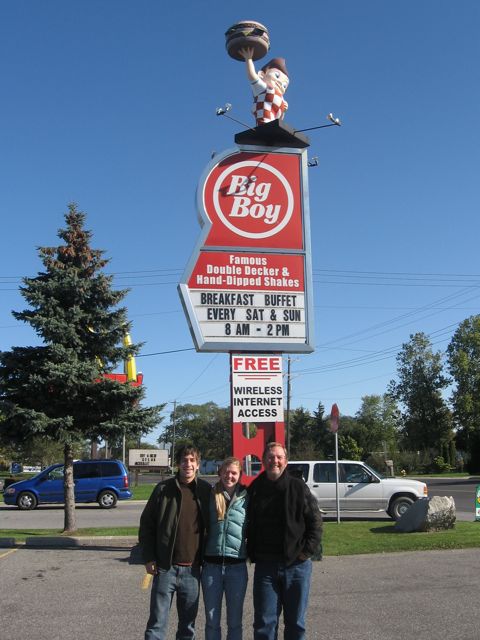
Emma and Jon are good company, and I was touched that they drove more than three hours from Oberlin College to see me. They were so bright and energetic that we old folks just watched them and marveled. We groan whenever we get up out of chairs. They play lacrosse and Ultimate Frisbee. We struggle to remember names and places. They take college courses in organic chemistry and molecular biology at the same time. Yet they seemed impressed by what we were doing, which made us feel better. We drove down the road and had Big Breakfasts at Big Boy, a Midwest landmark that has special childhood significance to Emma. Then they left to go back to work, and we broke camp.

RV park culture was in full flower at Algonac. The rigs were decorated with colored lights, and some people had hung carved-wood signs with their names and home towns on their propane tanks. The style is to put a large square of indoor-outdoor carpeting next to the entrance of your rig, and also to put a pink sweater on your small dog. The whole scene had a bizarre cast. The campground was wedged between a busy highway on one side and a shooting range on the other, so starting at 9am there was the constant sound of gunfire and traffic. Yet the place was full. People had driven up from Detroit to spend the weekend here. Why?

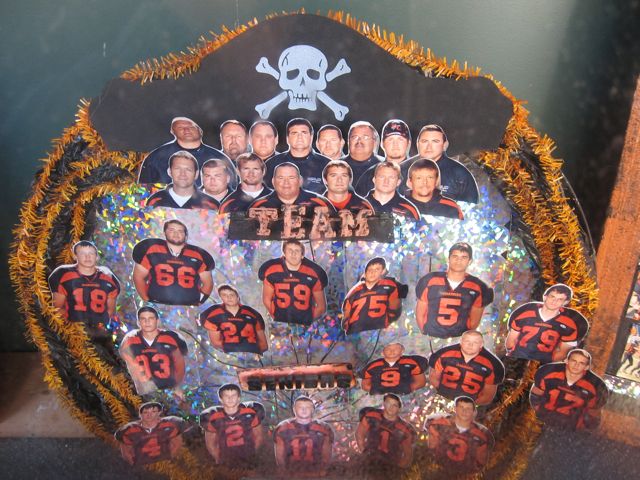
Marine City has two small ferryboats that go across the St. Clair River, which is maybe 500 yards wide. Only one Homeland Security officer was on duty there to protect us from terrorists, but he was extra-nasty and didn’t allow me to take any pictures. So while we waited, we walked down the street. It was Saturday morning, October 4th, and we saw the leavings of the Marine City Pirates’ high school homecoming game, which had happened last night; I didn’t learn the score. On the rail trail we had ridden past students dismantling one of the parade floats, a pirate ship which sails made out of bags of potato chips.

The ferry ride was quick and the Canadian policeman let us right in, although she did insist on seeing our passports. We drove a few miles into Canada before unloading the bikes. We started off around 2pm with 50 miles to our destination, Rondeau Provincial Park on the north shore of Lake Erie. Most of the ride was south through more agricultural fields, but there were subtle signs that we were in a different country. The roads signs were in French and English, of course. More intriguing were the political posters for Ontario’s elections, which are also coming up. The Conservative Party’s signs up here are blue, and the Liberal Party’s signs are red.

We rode into the town of Dresden, where we ate potato soup and grilled cheese sandwiches at another diner where the locals acted like they had never seen men wearing black tights. Then we rode just out of town to the site of “Uncle Tom’s Cabin,” which is what the government calls the residence of Josiah Henson (1789-1883). Henson was born a slave in Maryland. After escaping to Ontario with his family, he became an abolitionist leader and bought a 200-acre farm here in 1841. He ran a vocational school for slaves who escaped on the Underground Railroad, and his memoir, published in 1849, inspired Harriet Beecher Stowe to write Uncle Tom’s Cabin. Henson later presided over a black community named Dawn, and he continued to organize after slavery had been abolished in the U.S. His home site now has a large interpretive center that details the experiences of the African diaspora in Canada. It would take several hours to see it. We didn’t have the time, so for the thousandth time, we vowed to come back.

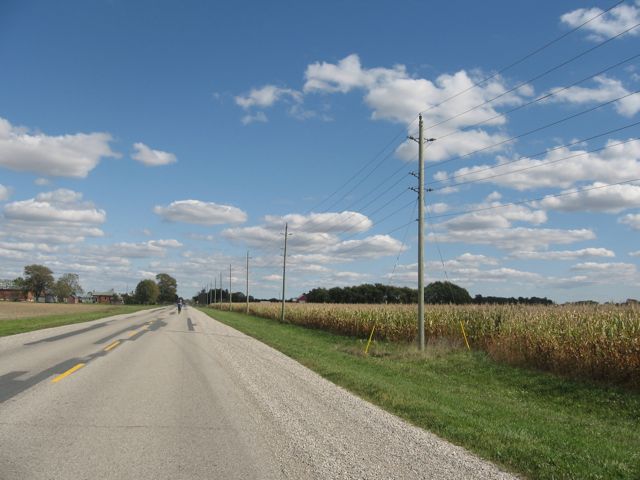
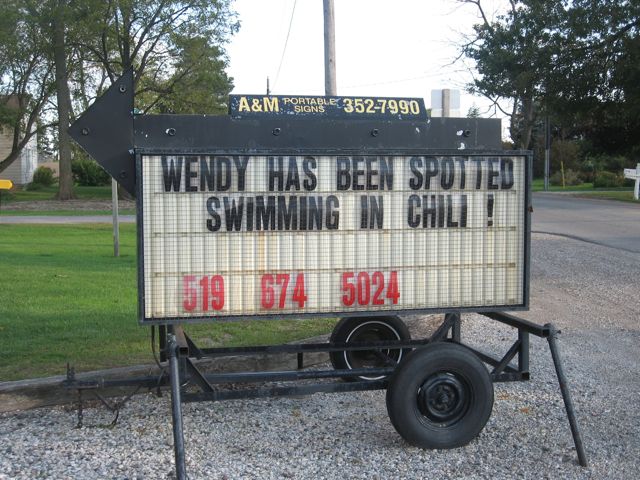
Most of the ride happened on a flat, straight provincial highway called Kent Bridge Line (roads are called “lines” up here). It was harvest time, and we rode past threshers cutting wheat and field workers picking plum tomatoes. At one hamlet we saw an intriguing sign about the personal habits of Wendy; I don’t know the details, but feel free to call the phone number if you’re curious. We pulled into Rondeau Park around 6pm and set up camp. Tomorrow would be another short day. We should have time to look around the park before we start heading east along the Canadian shore of Lake Erie.

Categories
8. Ontario Bicycling Across The USA

Through Ontario, Oct. 4 to 10

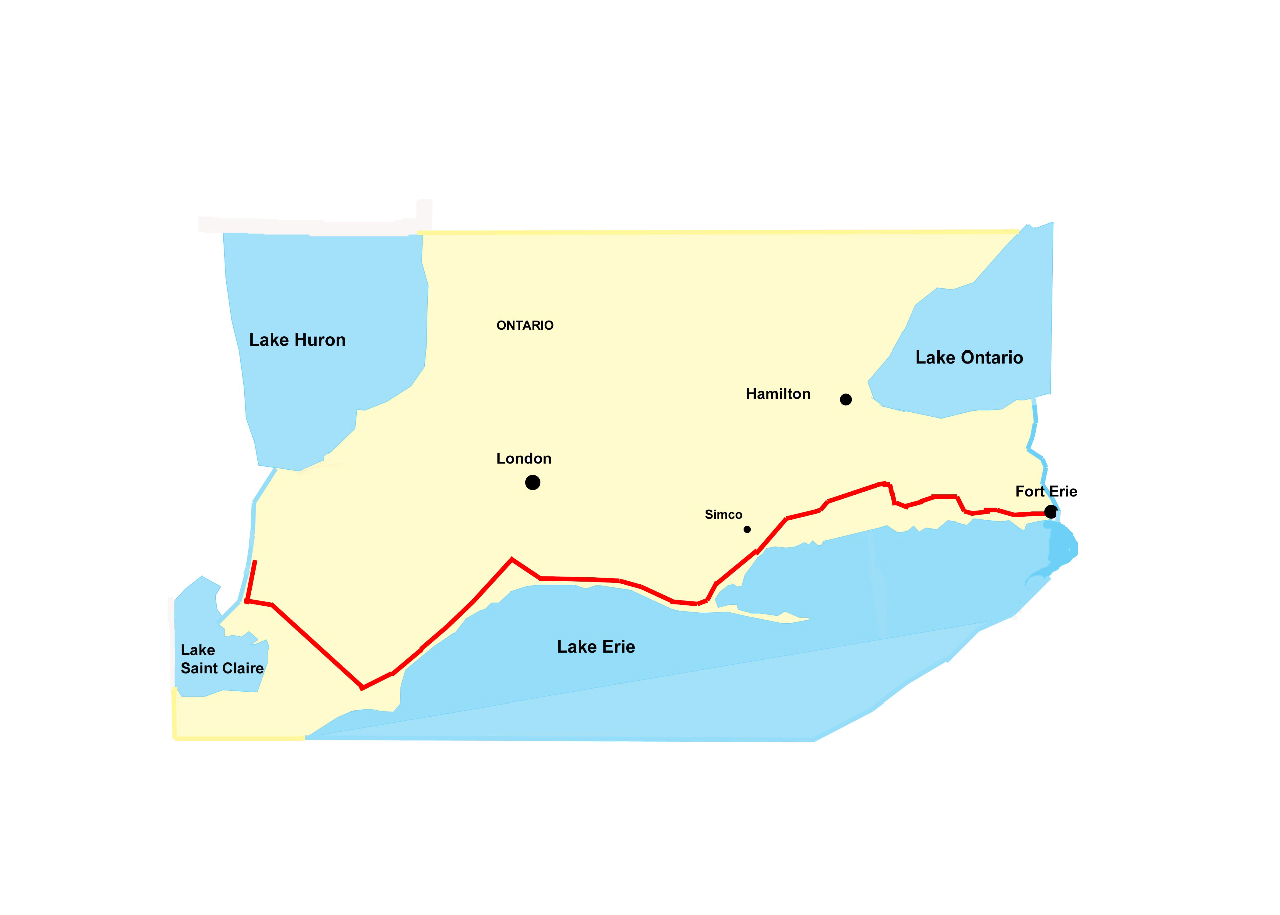
ontario-c2c4We crossed the St. Clair River on the Blue Water Ferry at Marine City and started through Ontario on Saturday afternoon. We will continue on the Adventure Cycling Association’s “Lake Erie Connector” route until we leave Ontario at the Peace Bridge in Buffalo at the end of the day on Thursday, On Saturday we went east from Wallaceburg and south on provincial route number 15, the Kent Bridge Line (they call roads “lines” here), to a campsite at Rondeau Provincial Park. On Sunday we rode east on provincial route number 3, the Talbot Trail, until it veered to the north; we stayed south on smaller roads that hugged the lake shore. We stopped the bikes in Port Stanley but continued in the truck to St. Thomas, a larger town a few miles away, because the truck needed repair.

We continued east on Monday from Port Stanley on small provincial roads along the north shore of Lake Erie (24, 42, 6, and 3) to Long Point Provincial Park, where we took a day off on Tuesday. On Wednesday we pressed through a rainstorm to Rocky Point Park, and on Thursday we reached Crystal Beach, near Fort Erie. Then we crossed the Peace Bridge at Buffalo and entered New York on Friday.

Categories
8. Ontario Bicycling Across The USA

Day 55: Rondeau Park to St. Thomas, ON

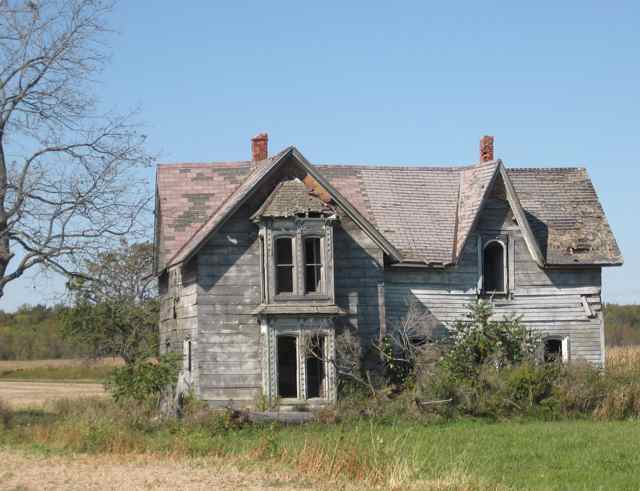
Colonel Thomas Talbot got a grant of 7,000 acres along the north shore of Lake Erie after retiring from the British military in 1803. He also cut a deal that would give him even more land for every settler he persuaded to prove a homestead there. Talbot made the most of the opportunity, building a 300-mile corduroy road along rich farmland between the Niagara River and the St. Clair River. The area was settled between 1820 and 1840, and Talbot was known as “The Benevolent Dictator of the London District.” The region he settled is still one of Canada’s most productive agricultural areas. The road also lead to the development of Buffalo and Detroit. But Talbot never married, so the government took his land back when he died.

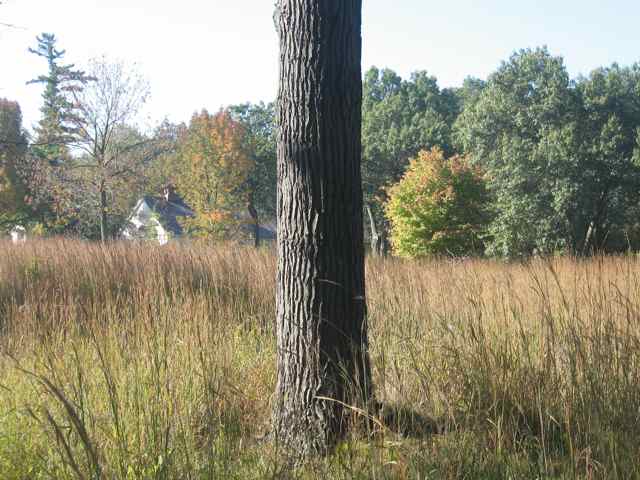
We saw echoes of the original Talbot Trail in tidy mid-19th century brick farmhouses along the route, as well as homesteads that didn’t make it. We slept late on Sunday the 5th because our rides in Ontario should be fairly short, and also because it’s too cold now to ride first thing in the morning. The late start gave us a bit of time to walk down the shore of Lake Erie at Rondeau Provincial Park, which was a revelation. I saw fine sand and miles or unbroken woods stretching southward in a peninsula that juts into the lake. Rondeau is one of Canada’s oldest parks, so the woods here are near maturity and the land has been managed well for biodiversity. It is a beautiful place, and it was nearly empty of people on a sunny Sunday in October. It would be a great place for a long hike.

After an unsuccessful attempt to find an internet connection in a nearby town, we ate a late breakfast at a diner in Morpeth and started east on the Talbot Trail. The truck was leaking brake fluid, and we learned from Sara that the leak got a lot worse as she drove ahead of us to our destination, Port Stanley. We needed to get it to a mechanic in the morning. So we rode the 45 miles as fast as we could, passing natural reserve areas and the Lake Erie shore in a few places but mostly staying in agricultural land. I could see enough to understand that this would be a great place for birdwatching, hiking, and lying on the beach. But we had a problem to work out.

Port Stanley is an upscale town people describe as “quaint,” which meant that it had no affordable lodging or campgrounds. We re-filled the truck with brake fluid and headed north to St. Thomas, a larger town about 15 miles north. We located a car dealer, a Comfort Inn, and a restaurant, which gave our credit cards a small workout. We fell into bed by 10pm, awaiting the morning’s verdict on the truck.

Categories
8. Ontario Bicycling Across The USA Land Stewards

Days 56 & 57: St. Thomas to Long Point, ON

Car trouble stopped the trip and made us anxious on Sunday night. On Monday the 5th, Jim got up early and took the truck to the dealer while Sara and I waited in our luxurious hotel rooms. At 10 am Jim returned with good news: one of the brake lines had rusted through, and the repair was relatively minor and quick. We were back on our bikes by noon.

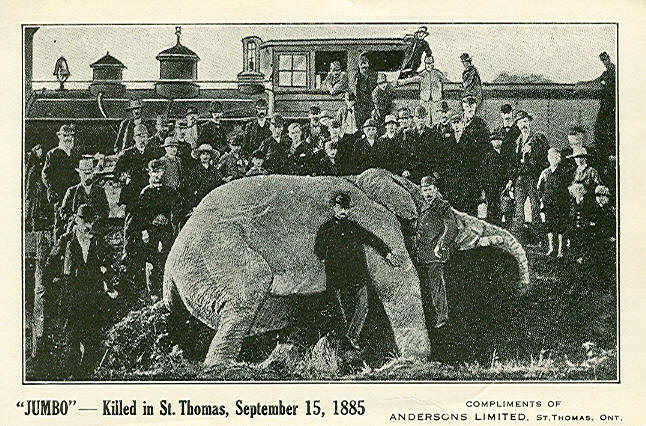
St. Thomas was not on our route and we didn’t see much of it, but there was one notable thing. Jumbo the elephant, an international celebrity and the star of P.T. Barnum’s circus, died here 123 years ago. His death was a high point for yellow journalism. Here is the dispatch from the New York Sun of September 18th, 1885:

“After the show in St. Thomas, the elephant driver started down the track with Jumbo and the baby elephant, Tom Thumb, to where the Grand Trunk Freight train was standing. There are a great many tracks at that point, used in switching cars on the Grand Trunk Air-Line, which there joins the main track. There was a train and on the other a steep embankment. As a train came around the curve the keeper tried to induce Jumbo to go down the embankment, but he would not.

“The reason at first was not apparent. The baby elephant was in the rear, and as the train approached Jumbo began to bellow and swing his trunk. The little elephant seemed dazed, but did not get out of the way. As the engine was closing upon them Jumbo raised on his hind legs as though to protect the baby, and then quick as thought dropped down and grabbed him in his trunk and hurled him with great force over all the tracks and against a freight car, twenty rods away, where he dropped down, whining like a puppy with a sore foot. Jumbo in saving the life of his protégé, entirely neglected his own chance to escape. The locomotive struck him will force in the side, crowding him against some cars on the siding nearest him and fairly squeezing the life out of him.

“When they came to the end of the switch the engine left the tract with five freight cars that stood on the siding. Then there was a scene never to be forgotten by those who witnessed it. The mangled beast roared with pain, and the little elephant roared as loud as he could in sympathy. The crush was too heavy to leave any chance of recovery and the bystanders could only wait for Jumbo’s death. It was not long delayed. In three minutes he turned over on his back dead. It was found that the baby elephant sustained a broken leg and as there was no help for him, orders were given that he be put out of his misery, which order was carried into effect yesterday afternoon.”

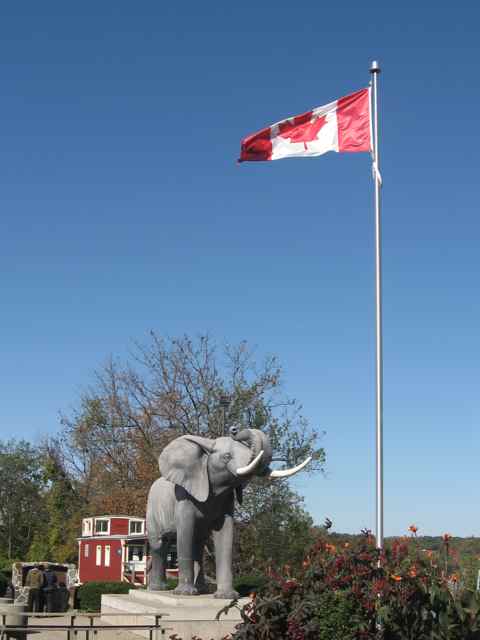
Other sources don’t support the story that Jumbo died trying to save a baby elephant’s life, so this may be another P.T. Barnum tall tale. But like so many of them,it stuck.  A century after Jumbo’s death, the community collected donations and erected a life-sized statue of the beast on the edge of a high embankment. It is a fine statue and a good story, and it makes me suspect that this must have been the biggest thing that ever happened in St. Thomas. Like Elvis or JFK, Jumbo became bigger in death than he ever was in life.

Barnum stuffed the hide of Jumbo and exhibited it for several years, and Barnum is the reason why we now say that something is “jumbo” instead of staying it’s extra big. After Jumbo’s hide stopped drawing crowds, Barnum donated it to Tufts University, where it became the official mascot. The hide was destroyed in a fire in 1975. According to Wikipedia, the ashes of Jumbo are kept in a 14-ounce Skippy Peanut Butter jar in the office of Tufts’ athletic director.

We said goodbye to Jumbo and drove to the provincial highway where we had stopped the day before. We started east around noon, with just 45 miles to go to our campsite at Long Point Provincial Park. The wind had shifted and was coming from the northeast, so we rode into it for most if the day. This slowed us down and might also have made us more observant. The road swung close to the lake and went past well-kept farms harvesting sweet peppers, apples, soybeans, potatoes, and corn. There aren’t many places in Canada where a farmer can make a good crop of sweet peppers, but the north shore of Lake Erie is one of them.

We stopped in Port Burwell at a restaurant that served fish from the lake. Jim made a face when he was offered perch, but I had a fine pickerel sandwich. Even more satisfying than the sandwich was the smug knowledge that I had eaten local food, as all good Greenies should. Sara had the same idea. She went to a farm stand and got delicious fresh peppers, potatoes, and tomatoes for us to feast on for dinner. East of Port Burwell we started to see wind turbines, which went on for 15 miles along the lakeshore. A roadside plaque explained that these were the Lake Erie Shores wind farm. There are 66 towers generating 99 megawatts of electricity here, enough to power 24,000 homes,

Not everyone is happy in this paradise of local food and clean electricity, however. We also saw lots of drying barns for tobacco that had been abandoned. The owner of a small general store in Clear Creek explained that the government had set aside $286 million to buy out tobacco farmers, but the money hadn’t arrived yet and the farmers were running out of options. He also explained to us why the Canadian shore of Lake Erie is not lined with second homes and cottages, as is every lakeshore in New York. Canadian farmers in this district are prohibited from subdividing their land, he said. Most of the shore is in an agricultural reserve program and is legally required to remain in production. He was not happy about this. It reminded me of the Adirondack Park, a place that city people treasure as a natural jewel while the locals grumble about not being able to make a living.

Day 57: Long Point Provincial Park

We entered the Long Point Biosphere Reserve, where a 25-mile sand spit that juts into Lake Erie is reserved for the use of migrating birds. The peninsula itself is a mixture of privately owned land that is protected by a Nature Conservancy easement, and a national wildlife refuge that is accessible only by boat. The government of Ontario, local citizen groups, Ducks Unlimited, the United Nations, and even the State of New York have contributed money and time to make sure that this area remains prime waterfowl habitat. Farms are paid to ensure that there’s lots of waste corn for birds to eat. No-nonsense signs keep you from walking into the bird areas. The fine for trespassing is $225.

The star of the show here is the Tundra or “Whistling” Swan, which is pure white except for a black bill and has a eight-foot wingspan. The swans descend on Long Point in late February and stay until mid-March, stopping to rest and refuel on their way from wintering grounds in Florida to their nesting sites in the arctic. When they’re here, the ranger said, they sit in the huge marshes that line the inland side of the peninsula and make an incredible racket. You have to see it to believe it, she said. But the big preserve is a mixed blessing for ducks, because you’re allowed to hunt them. We heard shotgun blasts until dusk.

The most remarkable thing about Long Point is that the public is not allowed to walk onto the spit itself. Five or six miles of private land separates the provincial park from the wildlife refuge, which runs to the tip of the peninsula. The private land is a hunting camp owned by a group of wealthy Americans and Canadians. The Nature Conservancy brokered an easement on this land, along with the donation that created the wildlife reserve. Unless you have a boat, you can’t get to the good stuff. Very clever. I was reminded once again of the way land conservation works in the Adirondacks.

We took Tuesday off and went into a nearby town to do some errands. We also walked around the Provincial Park, which was about to close for the season and was almost empty. But it was a clear, warm day, which gave me the unexpected but exquisite treat of sitting on a deserted beach in a camp chair and staring at the waves until my brain waves resembled a dial tone. We finish our Ontario ride on Wednesday and Thursday, and on Friday we start through New York.